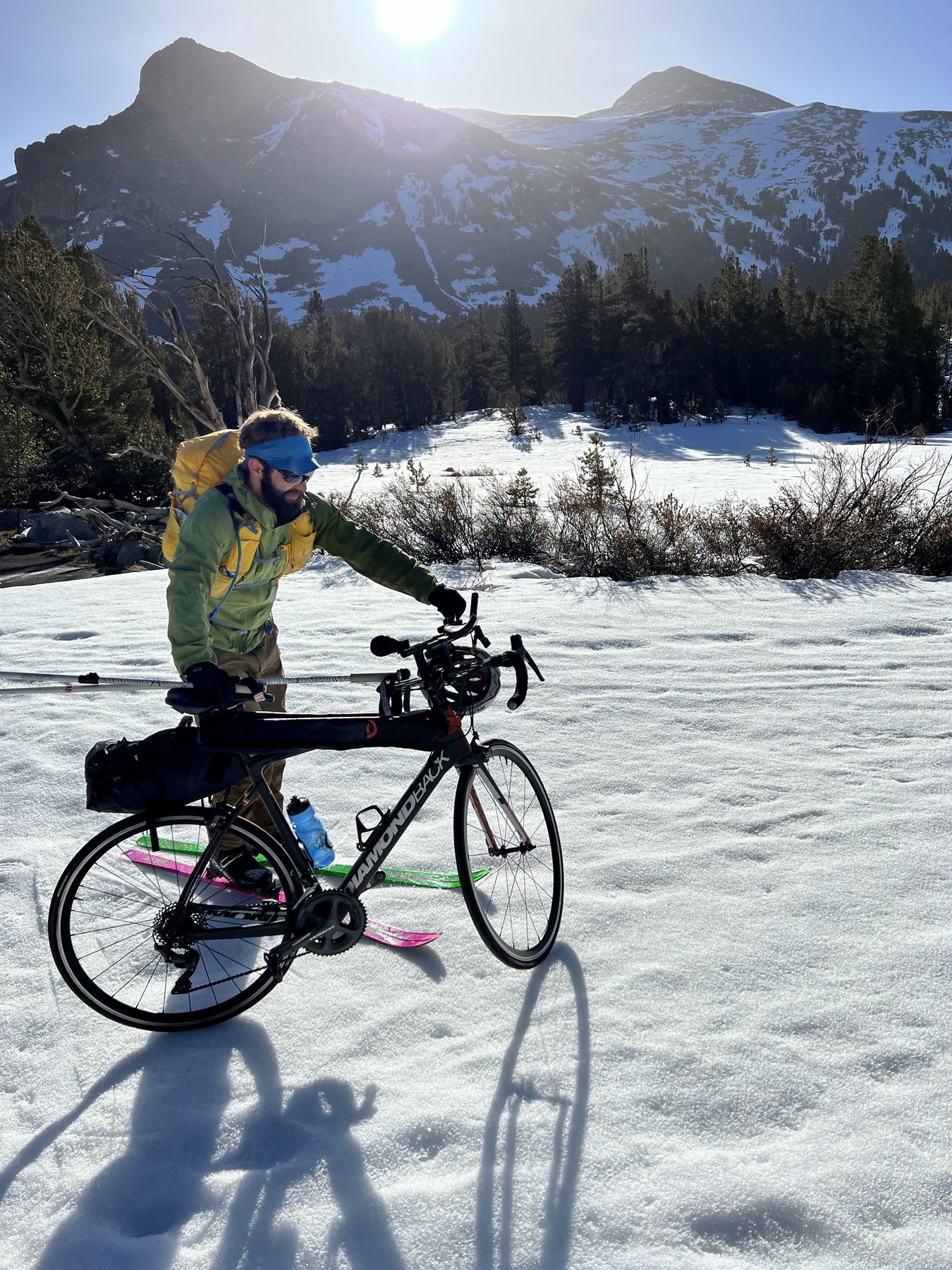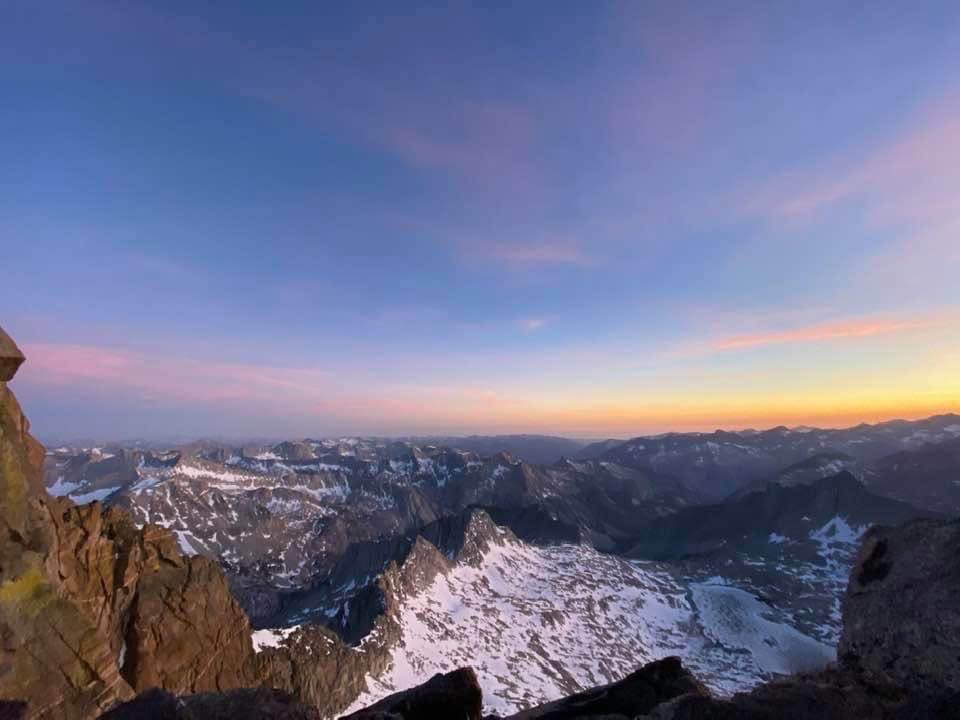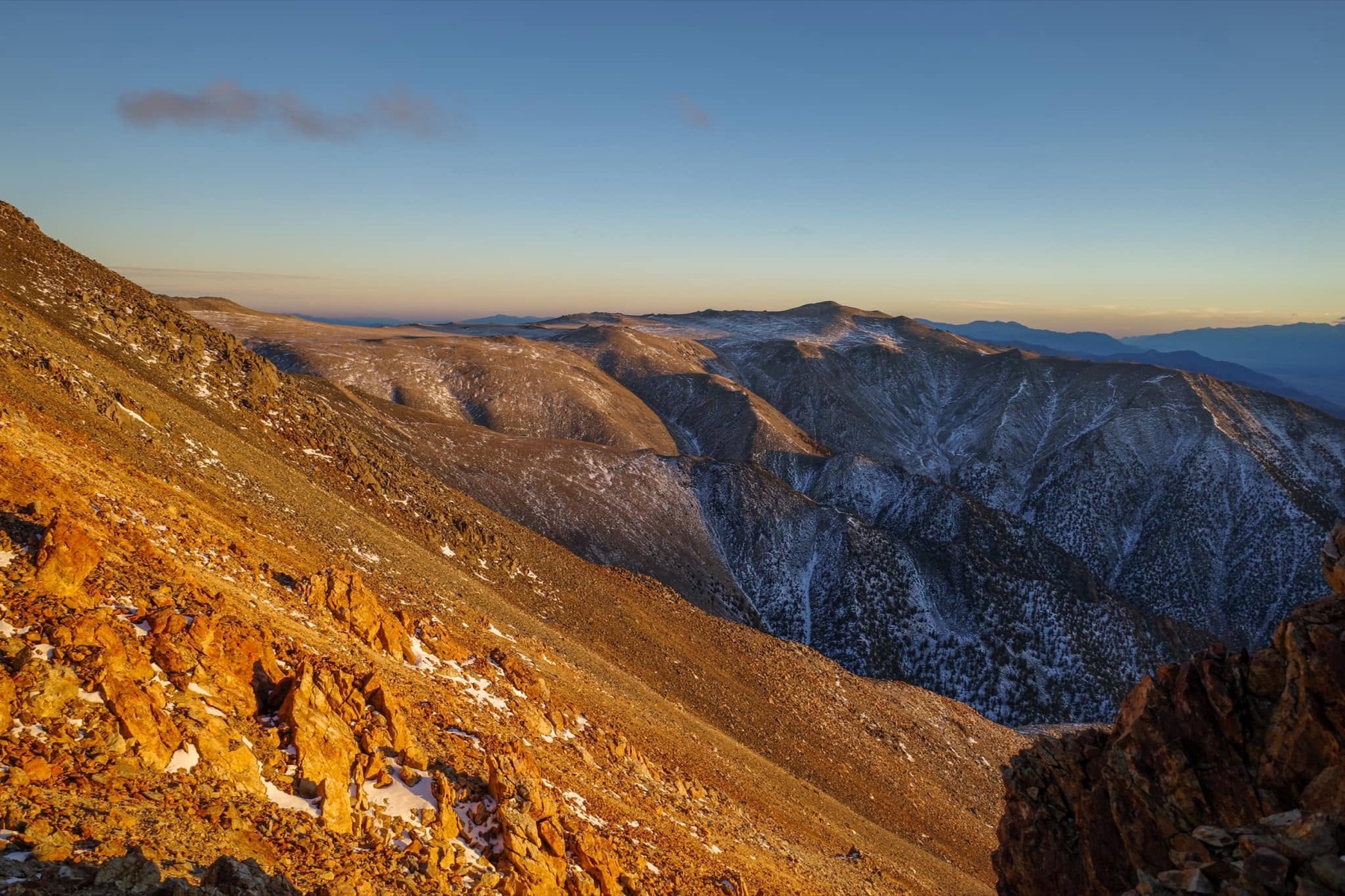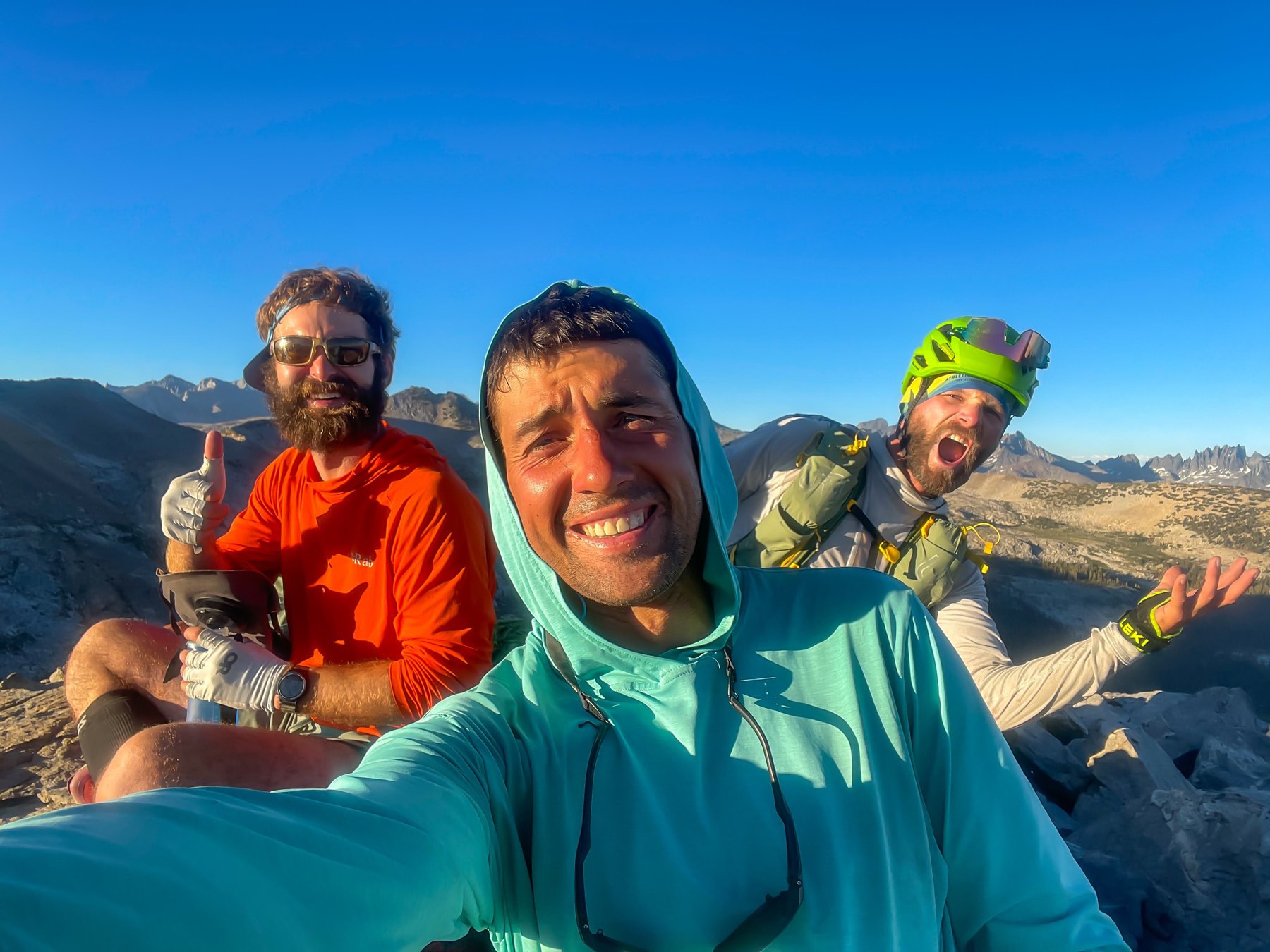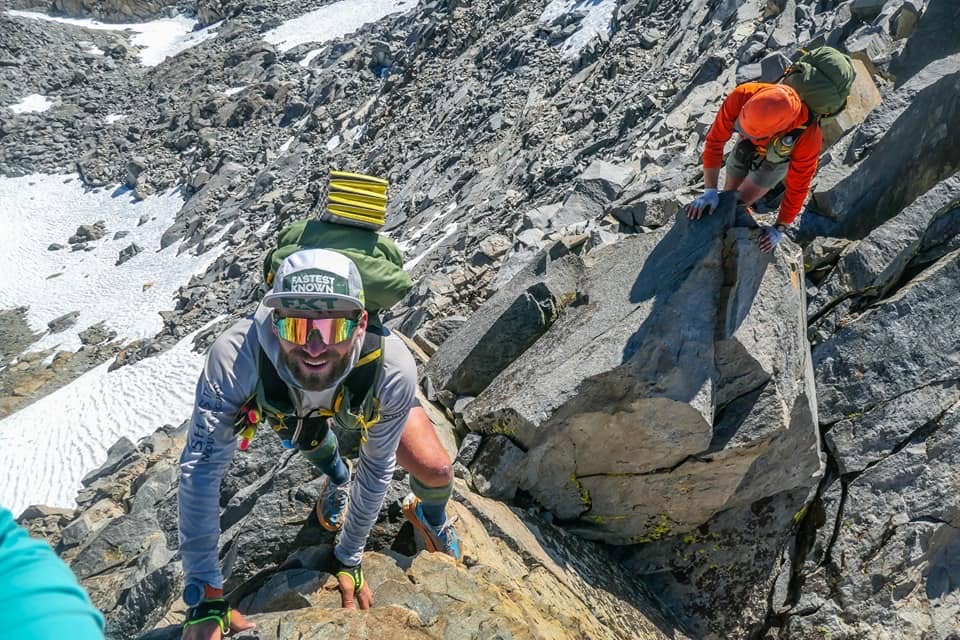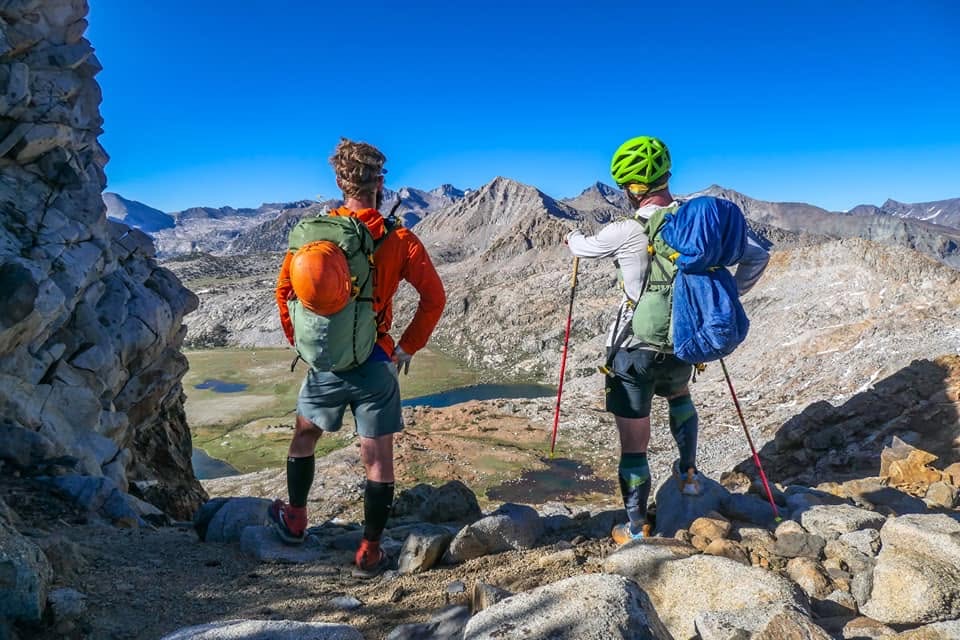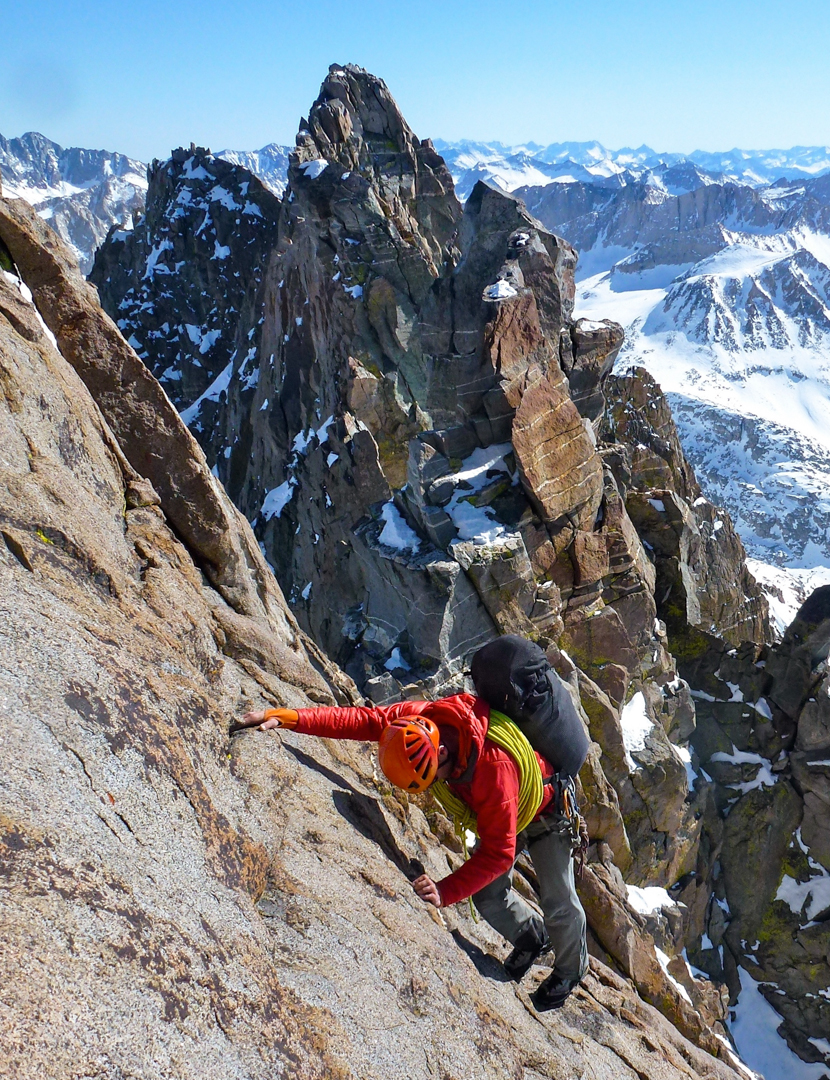
Sunrise over the Sierra high country

An unfinished history of moving fast in the Range of Light

BEFORE THE
CLOCKS.

The records, linkups and audacious days that shaped Sierra speed—documented with the honesty that “fastest known” has always demanded.

Explore the lines ↓

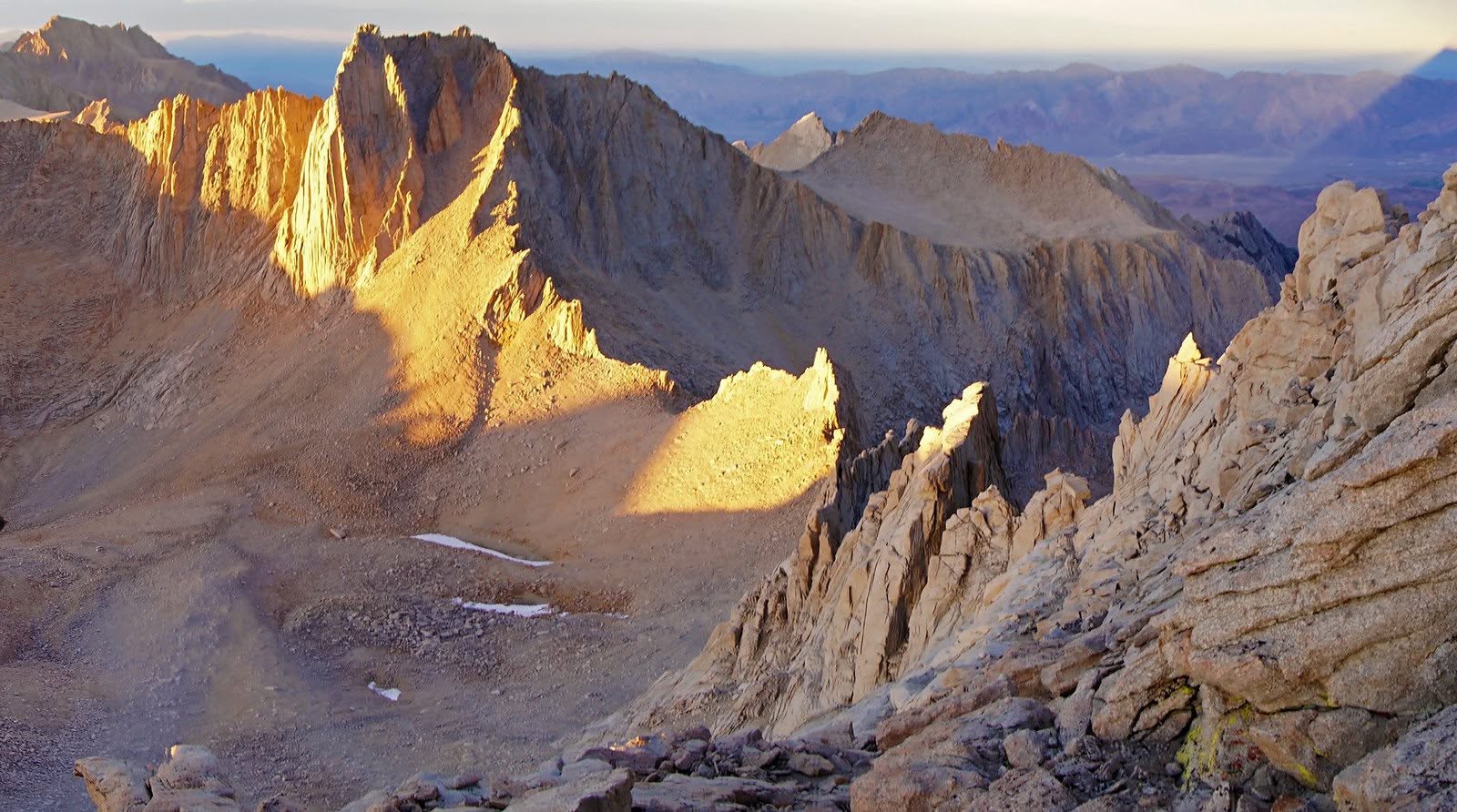
Palisades at dawn · photo by Ryan Tetz

“Fastest known time” leaves room for the person who already did it quicker—and whose story never made it online.

In 2012 Jediah Porter began Sierra Speed, a local ledger spanning trail running, peak ascents, technical climbing and ski mountaineering. This archive carries that idea forward: current times matter, but so do signed post cards at the Portal Store, half-remembered register entries, first attempts, style differences, and the people who imagined a line before it had a category.

History before hierarchyStyle is part of the storySources, gaps and corrections stay visible
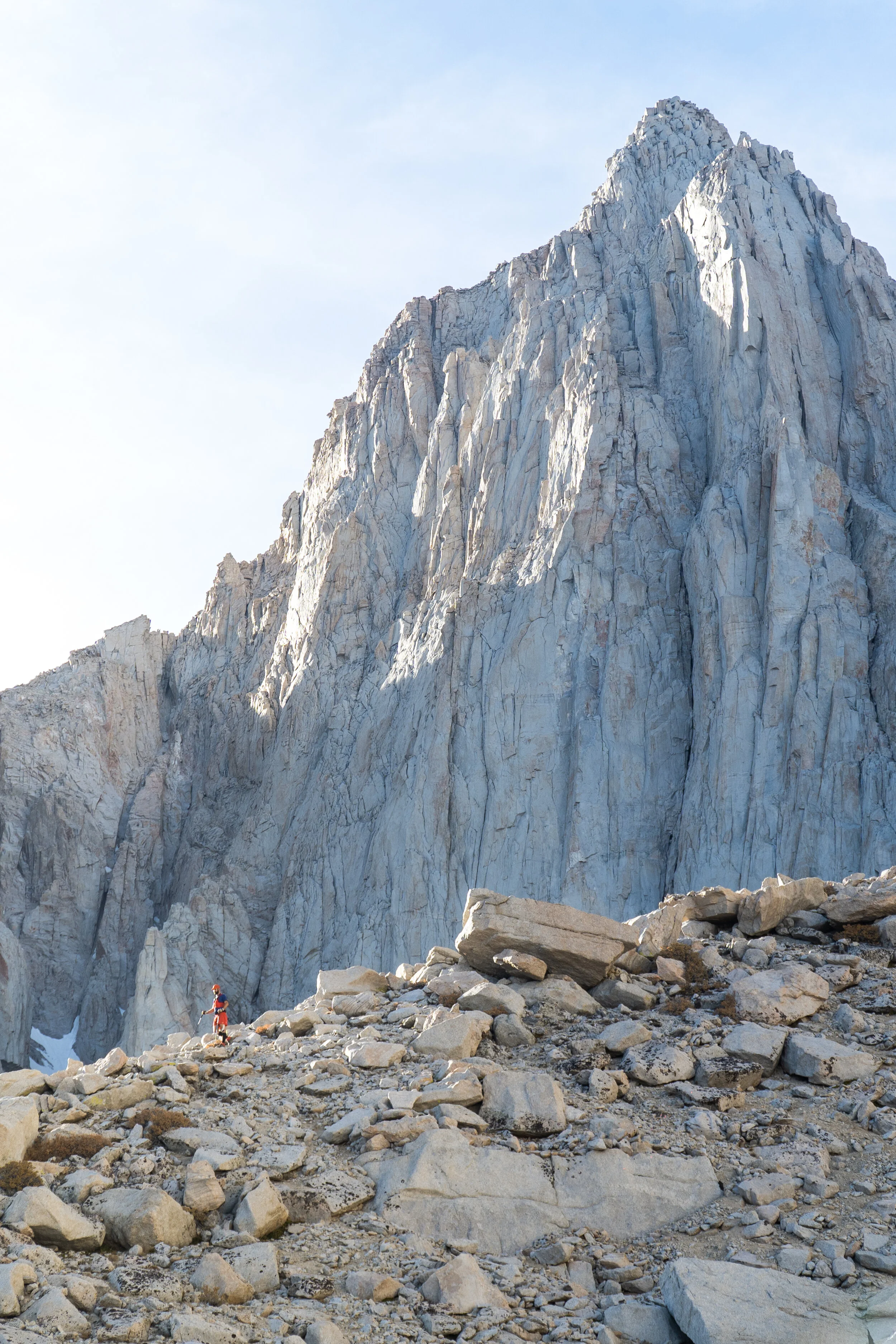
Ryan Tetz stands beneath Mount Whitney’s granite east faceWhitney region · Ryan Tetz archive

Mountaineer’s Route · witnessed history to GPS

FROM A
SIGNED POST CARD
TO 2:38:15.

Marty Hornick’s 1991 ascent was clocked by friends. Eleven years later Jason Lakey started under Doug Thompson’s eye and climbed the Mountaineer’s Route in 2:09:30. A post card was signed on the summit and returned to Thompson; Lakey stopped the round-trip clock at 3:10:07. The proof was communal because GPS watches were not.

Current listed men’s unsupported car-to-car2:38:15

Matt Dubberley · August 2, 2015
Ascent: 1:47:40
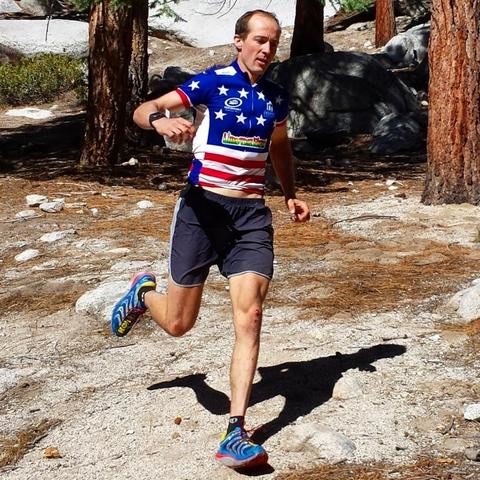
Matt Dubberley runs through the Whitney Zone during his 2015 Mountaineer’s Route record
Matt Dubberley during the 2015 Whitney record · supplied by Ryan Tetz

Brett Maune and Andy Anderson moved that record forward before Dubberley cut another 24:50 from Anderson’s round trip. His 2015 performance still tops the public FKT table for this exact route and style.
THE BIG SIX.
THE KEY
BEFORE THE CLOCK.

Sean O’Rourke established the Big Six during his 2012 California Fourteeners record push: Langley → Muir → Whitney → Russell → Williamson → Tyndall, trailhead to trailhead. The line became a key to unlocking the modern fourteeners and remains a readiness test for anyone preparing to attempt a California 14ers or Norman’s 13 FKT.

In the known record-push lineage, it has since been repeated only by Ryan Tetz, Jason Hardrath, Matt Zupan, Kilian Jornet and Olivia Amber. It is still one of the Sierra’s harder known 24-hour pushes. The “Talus Ocean Crossing” guards the back half of the line—a sustained passage of unstable granite that has stalled or ended would-be record efforts.

  1. 01Langley
  2. 02Muir
  3. 03Whitney
  4. 04Russell
  5. 05Williamson
  6. 06Tyndall
EstablishedSean O’Rourke

2012 California 14ers record push

Known record-push finishers6 athletes

O’Rourke · Tetz · Hardrath · Zupan · Jornet · Amber

Still used asReadiness test

California 14ers + Norman’s 13

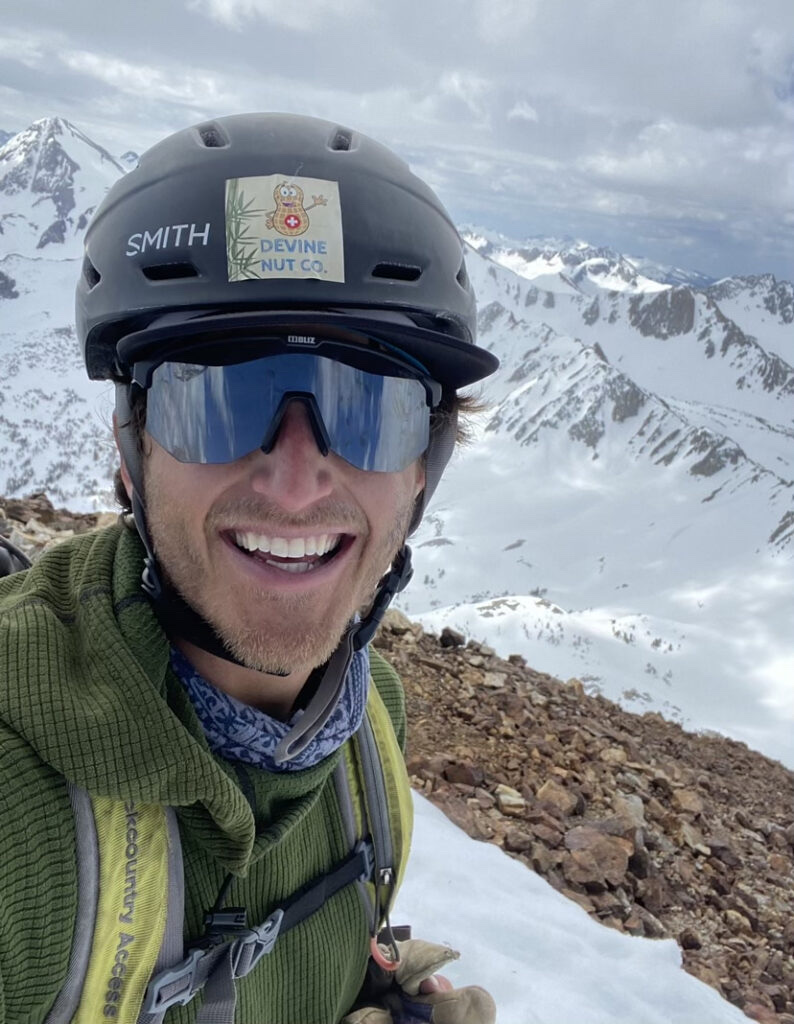
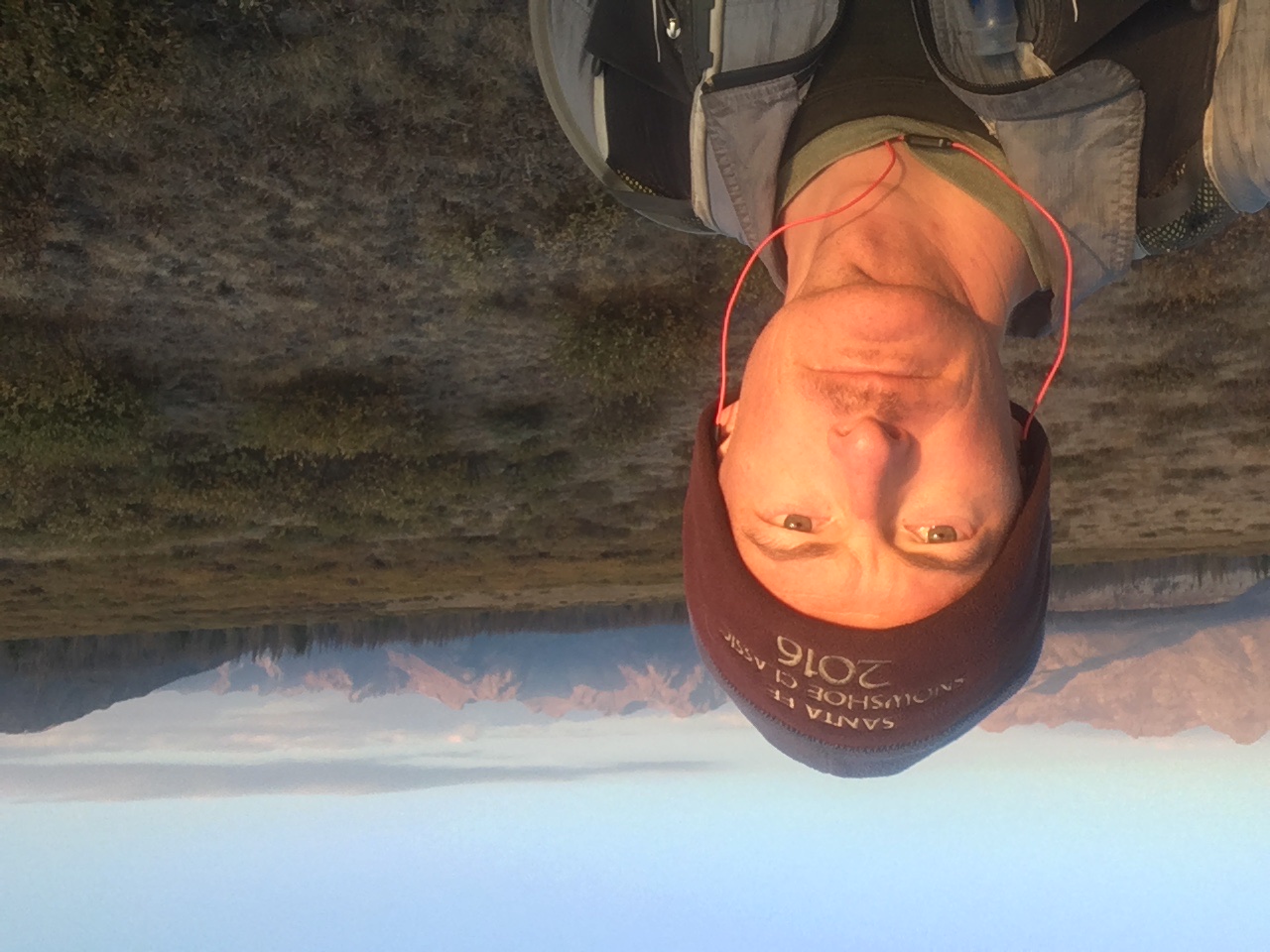
Sean O’Rourke takes a mountain selfie at sunrise with a high range behind him
Established line · 2012 · athlete portraitSean O’Rourke
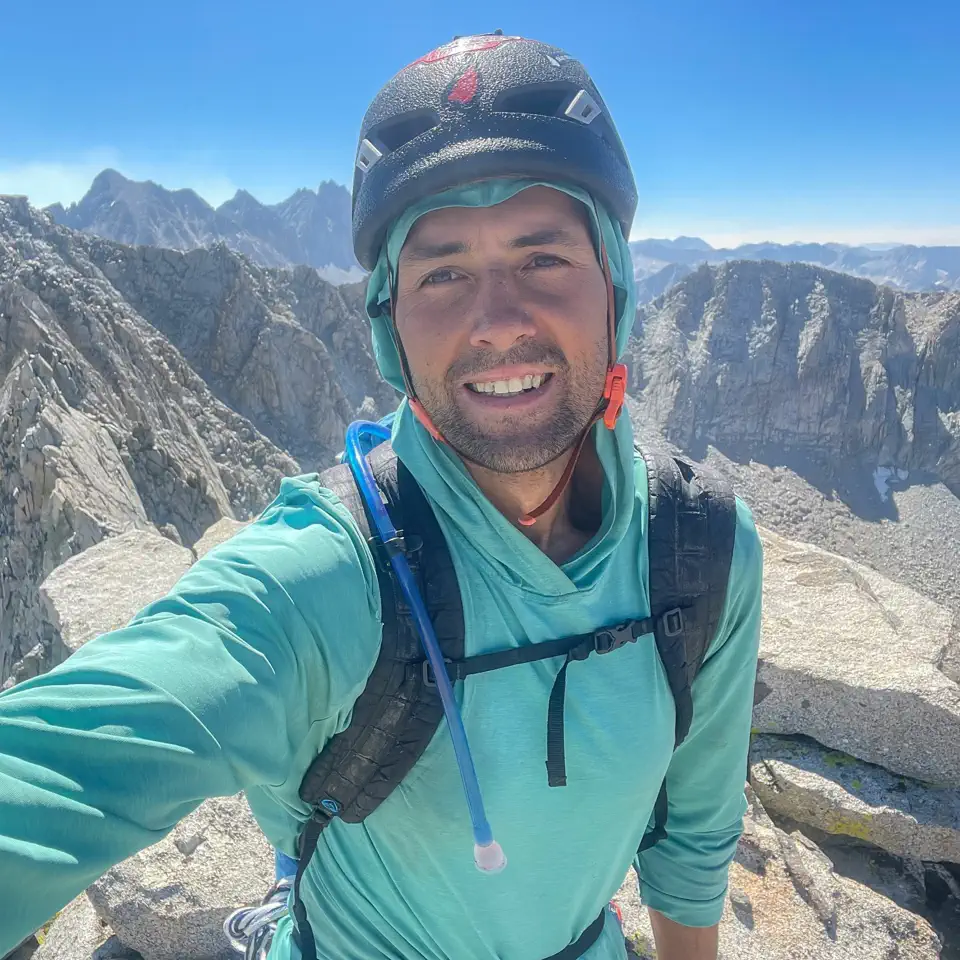
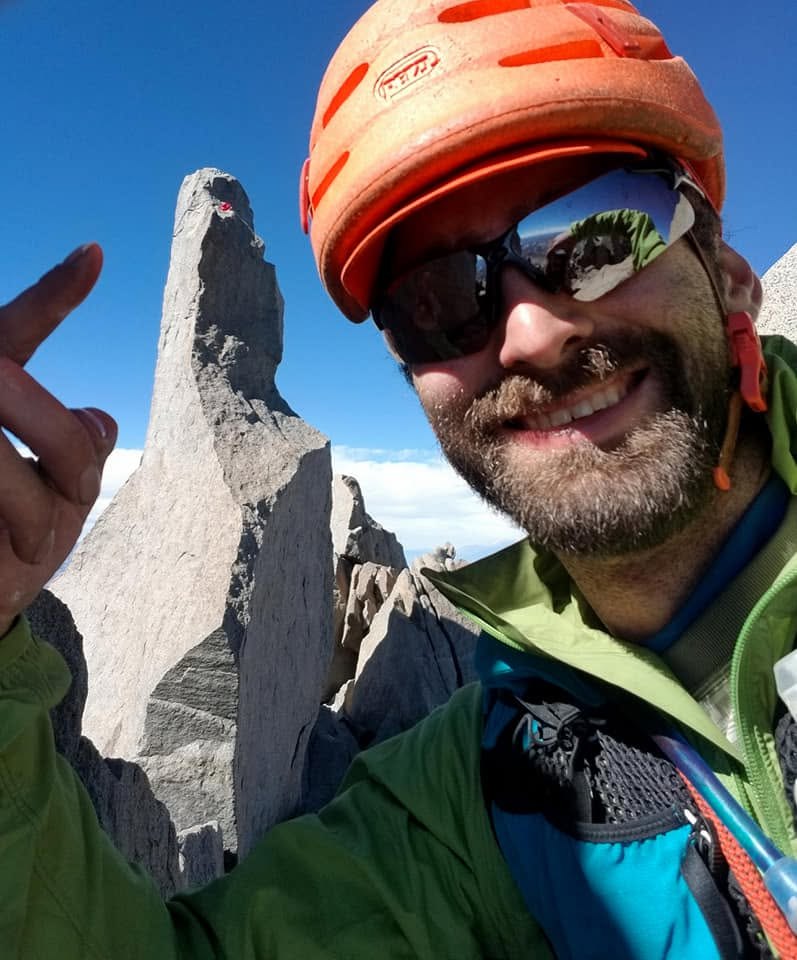
Ryan Tetz smiles in a climbing helmet beside a granite summit block in the California fourteeners
Record push · 2018 · effort archiveRyan Tetz
Matt Zupan smiles in a climbing helmet on a snowy Sierra summit
Record finisher · 2021 · athlete portraitMatt Zupan
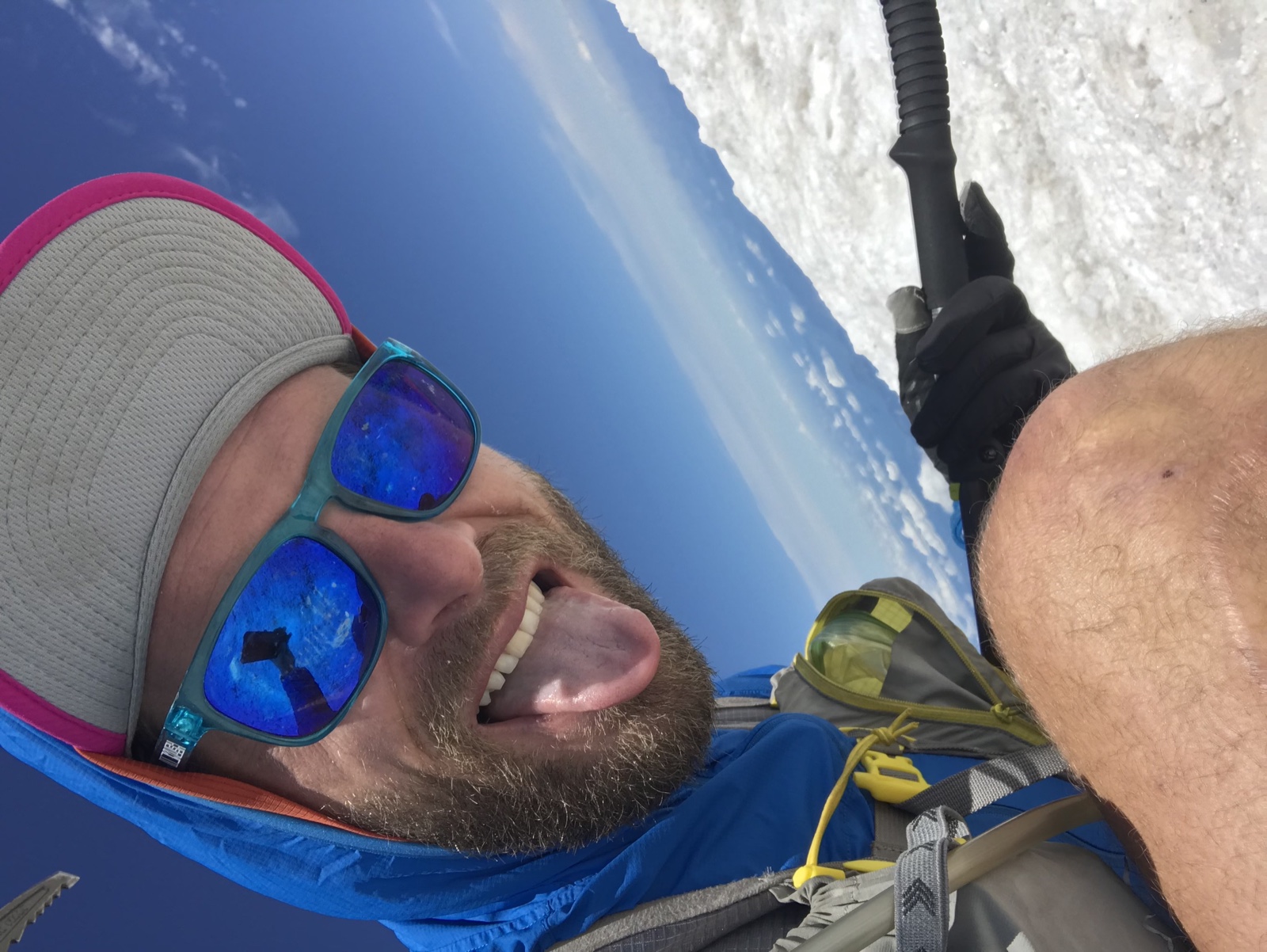
Jason Hardrath takes a solo mountain selfie in sunglasses on snow
Record finisher · 2022 · athlete portraitJason Hardrath
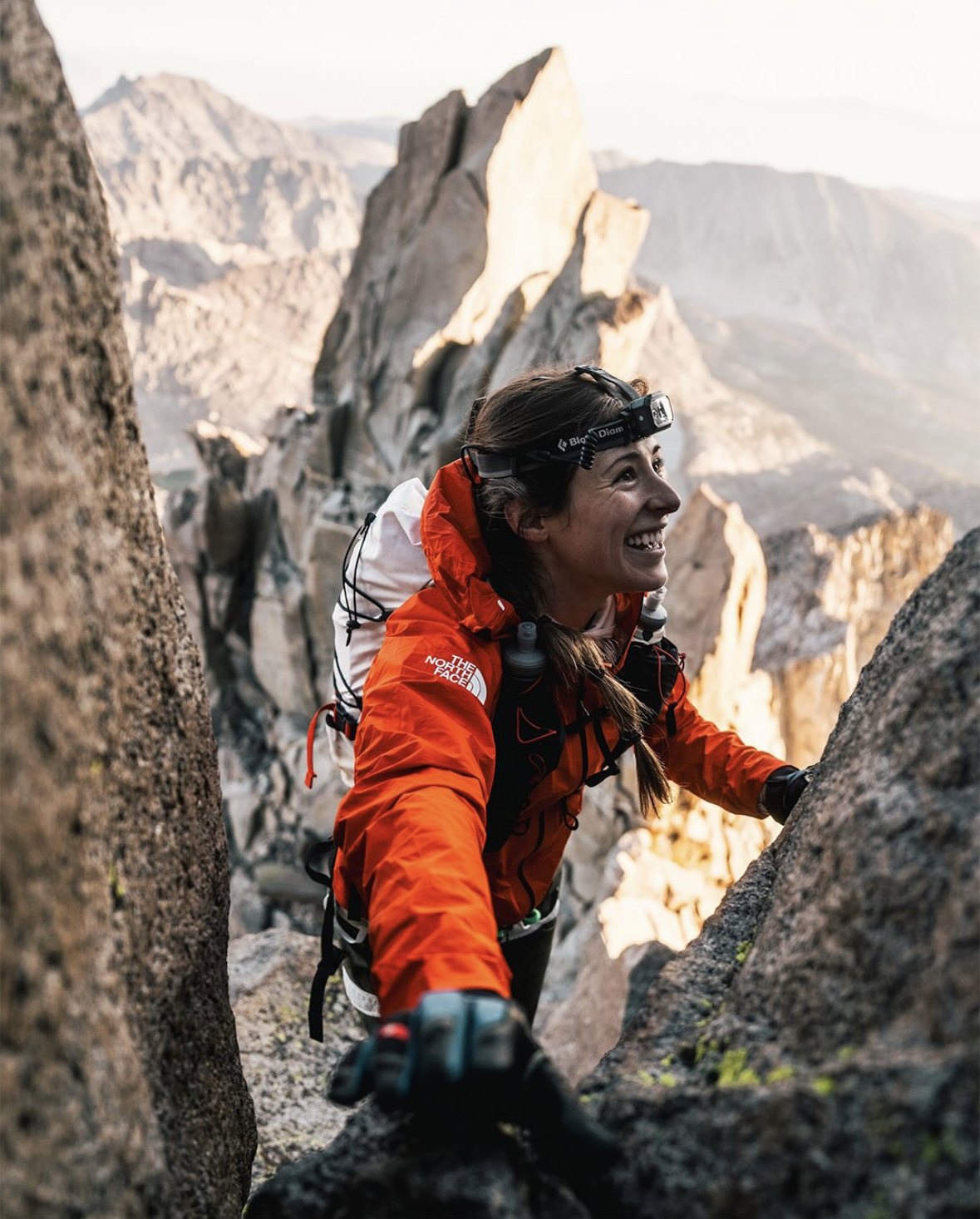
Olivia Amber smiles while climbing through high Sierra granite
Record finisher · 2025 · athlete portraitOlivia Amber
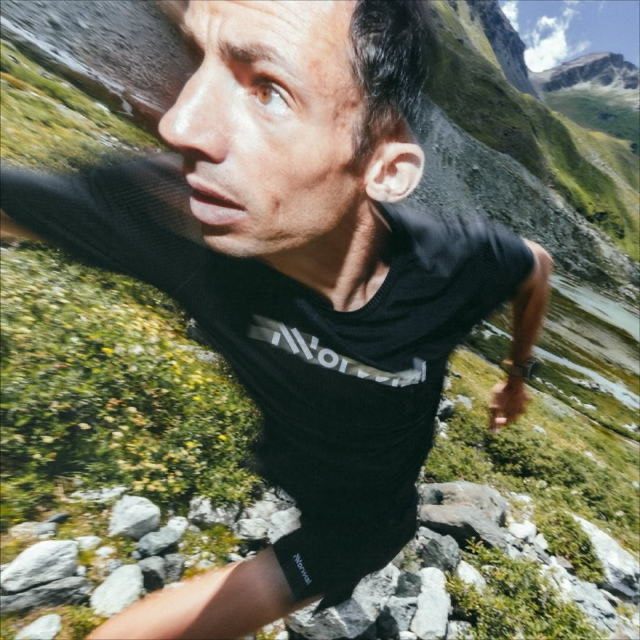
Kilian Jornet runs uphill through steep mountain terrain
Record finisher · 2025 · press portraitKilian Jornet
Golden evening light crosses the Mount Whitney–Mount Russell ridgeline and its broad fields of granite talus
Whitney–Russell ridgeline · Big Six route context · photograph by Peter Clark · supplied by Ryan Tetz
Ryan Tetz’s Big Six repetitionField film from his successful 2018 human-powered California fourteeners push · one of five known record-push repetitions after O’Rourke

FULL STORIES.
THEIR OWN
GROUND.

The ledger keeps the clocks; these field pages hold the photographs, films and fuller route histories. Follow Sierra crossings by road, trail and ski, then enter Yosemite’s summer and winter Picnics through the transitions that made each linkup possible.

Vitaliy Musiyenko takes a helmeted selfie on a high granite summit in the Sierra Nevada
Vitaliy Musiyenko · Sierra Nevada field portrait · supplied by Ryan Tetz

GOLIATH.
ONE CREST.
EIGHT DAYS.

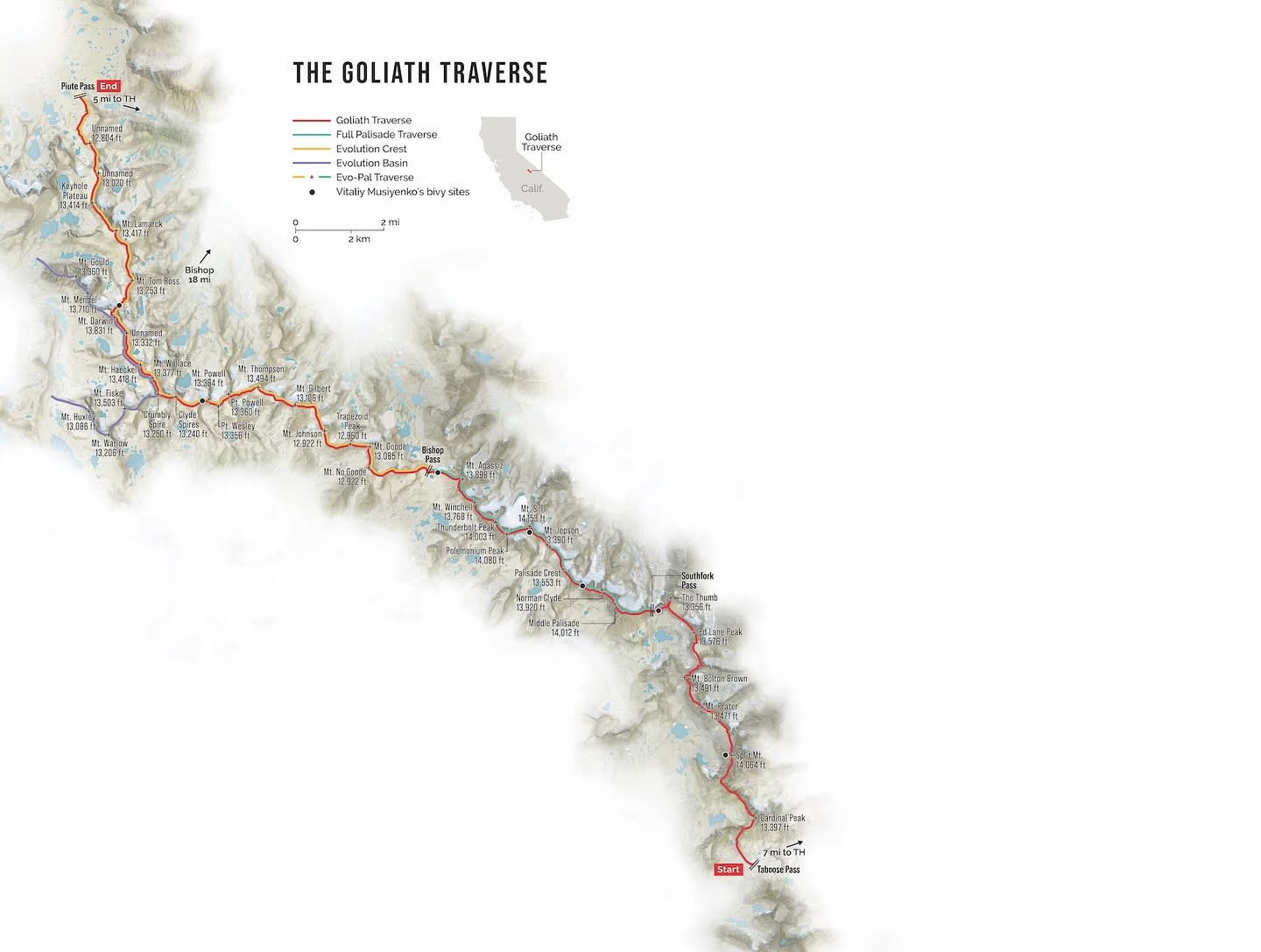
From August 2–9, 2021, Vitaliy Musiyenko moved south to north from Taboose Pass to Piute Pass, joining the new Full Monty with the Full Evolution Crest. Roughly 32 technical ridge miles, nearly 60 summits, eight days solo—without support or preplaced caches.

≈32technical ridge miles
≈60summits
8days
SOLOno support · no preplaced caches
Sunset colors the snowy Palisades during an early Full Monty and pre-Goliath traverse attempt
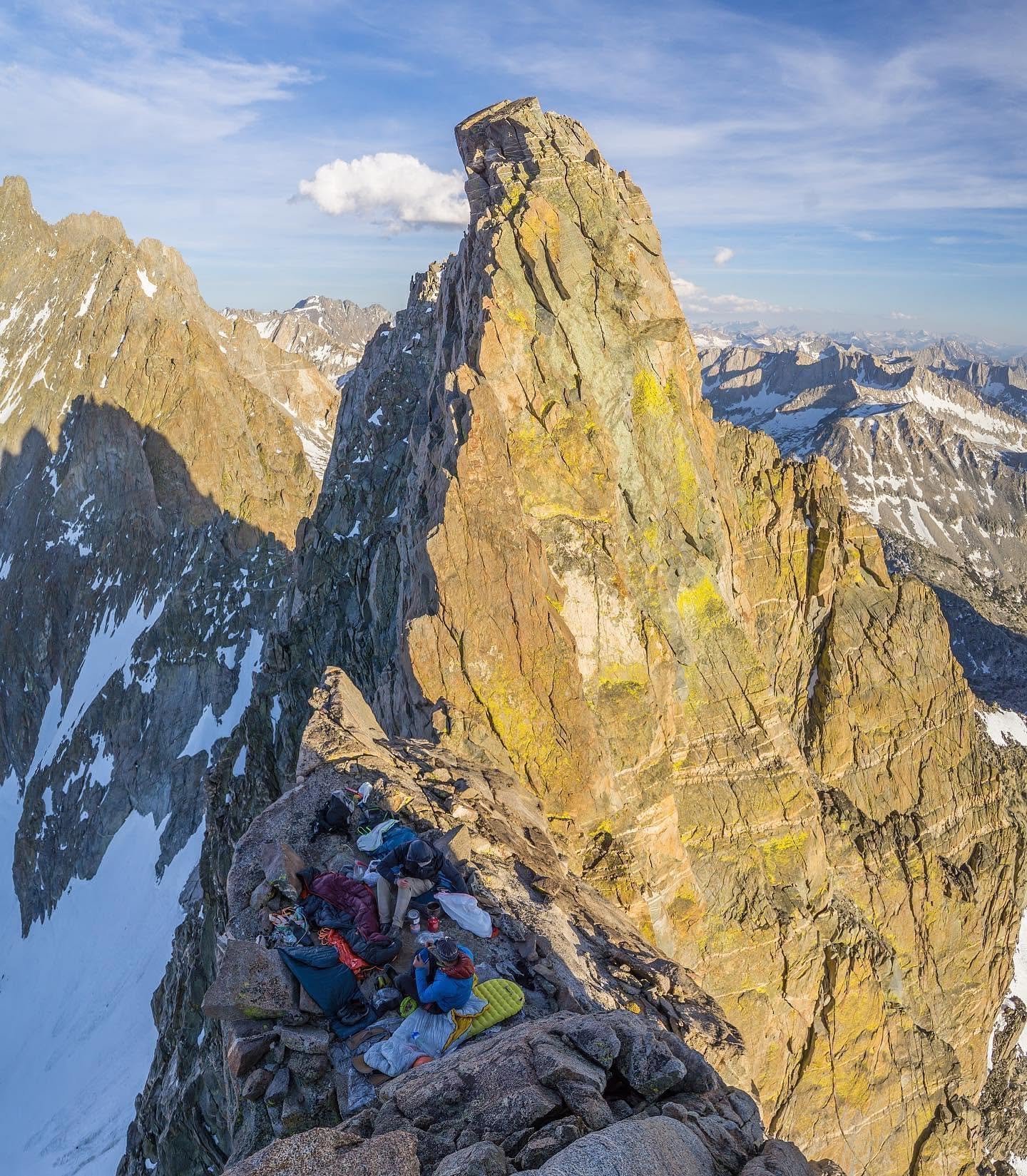
Vitaliy Musiyenko, Ryan Tetz and Sean O’Rourke bivouac on a narrow Palisades ledge during an early Full Monty attempt
Before GoliathEarly Full Monty / pre-Goliath attempt with Vitaliy Musiyenko, Ryan Tetz and Sean O’Rourke · photographs supplied by Ryan Tetz
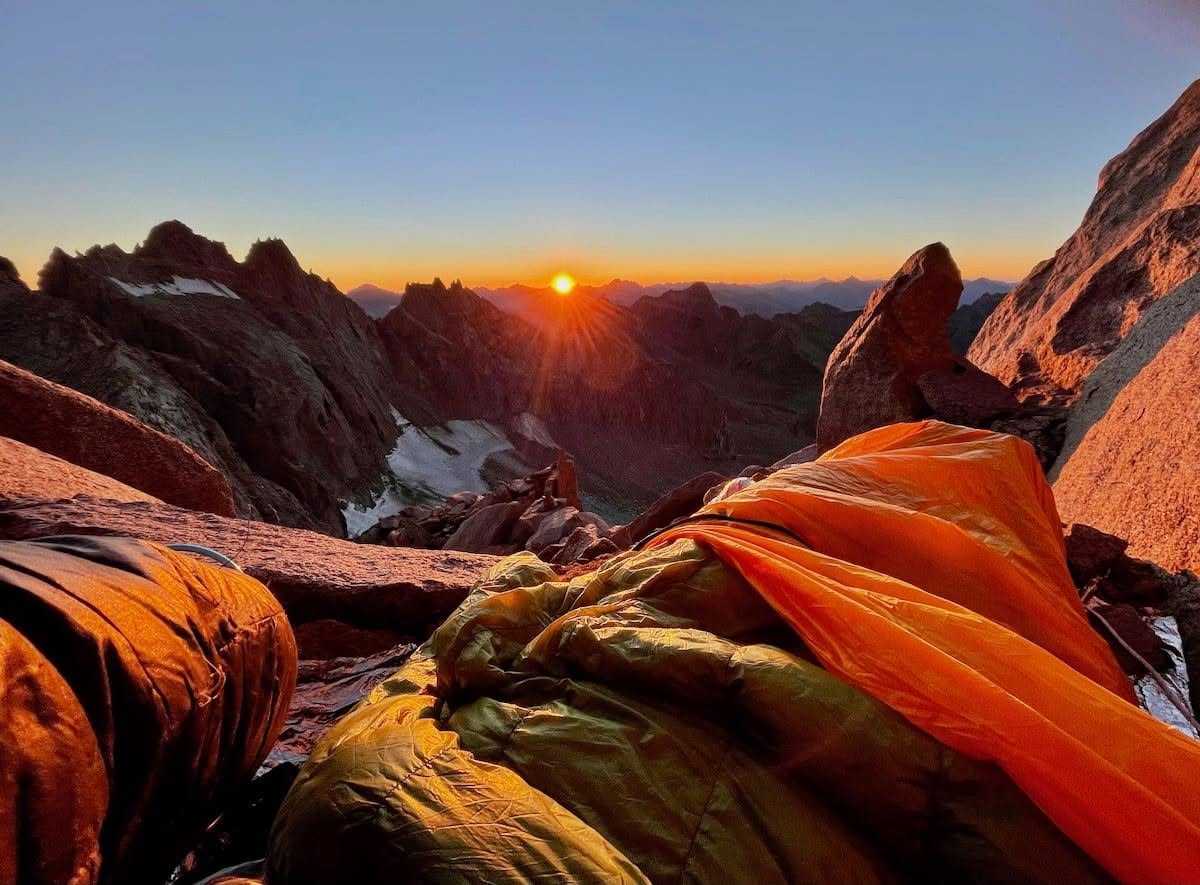
Orange sleeping quilts on a granite bivouac ledge below Mount Sill at sunrise, with North Palisade, Starlight and Thunderbolt beyond
Fourth bivouac below Mount SillNorth Palisade, Starlight and Thunderbolt at first light · Vitaliy Musiyenko
Map of the Goliath Traverse from Taboose Pass north through the Palisades and Evolution crest to Piute Pass, with neighboring traverse lines
The Goliath Traverse and notable Sierra crest traversesMarty Schnure / Maps For Good · Data: USGS

Musiyenko’s American Alpine Journal account records the line, the solo style and the eight-day progression across the Palisades and Evolution crest.

Read Vitaliy’s AAJ account ↗
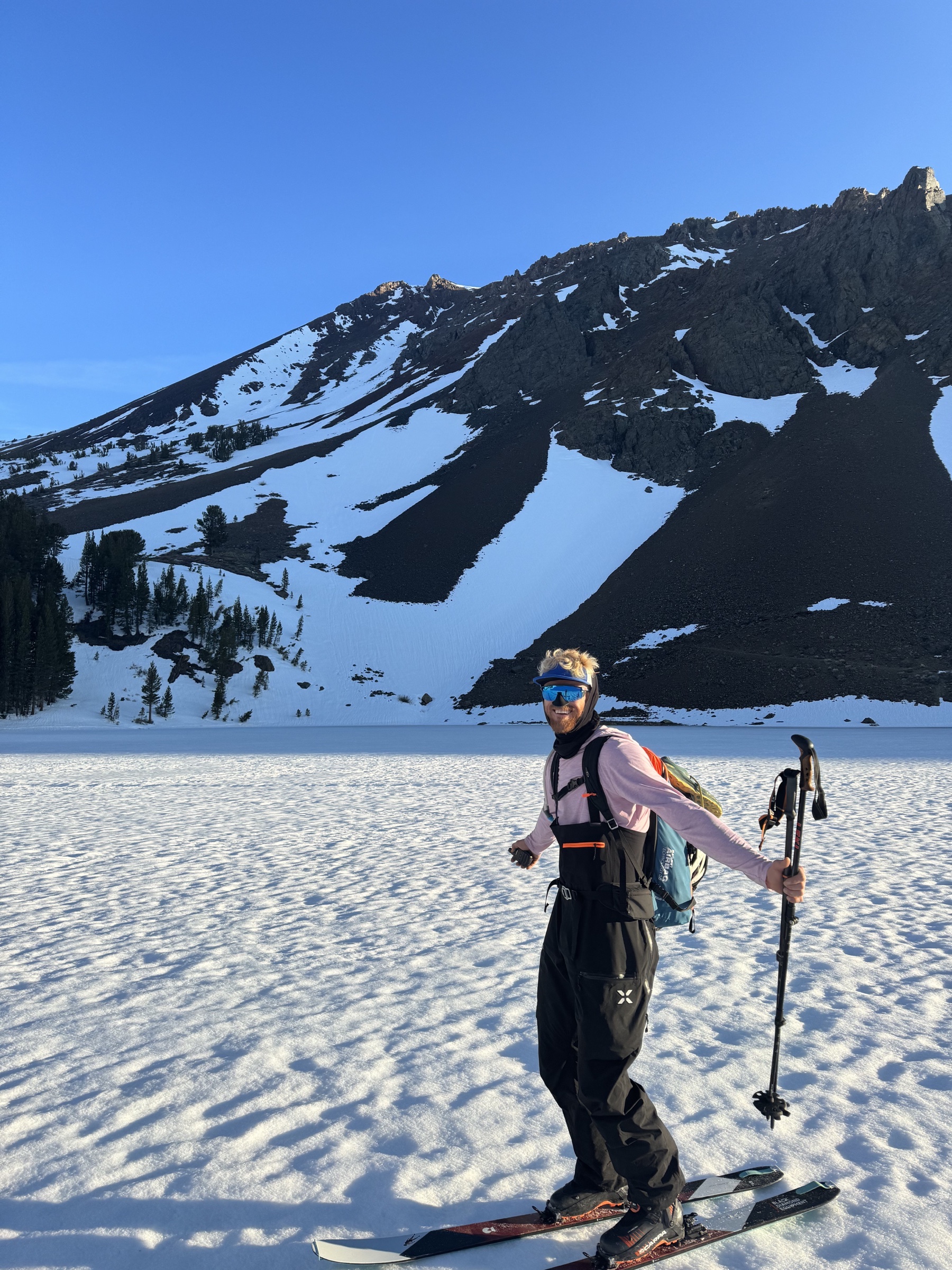
Jake Whisenant smiles on touring skis beneath a snow-streaked mountain ridge on a clear spring morning
Jake, spring 2024 · Ryan Tetz archive

Mammoth Lakes climber · first ascensionist · Yosemite speed climber

A SIERRA LIFE
IN MOTION.

Jake Whisenant was a Mammoth Lakes climber, route developer and endurance athlete whose curiosity moved freely between first ascents, ski traverses, fast technical linkups and Yosemite’s big walls. His fiancée Emma London’s remembrance traces a life built around friends, mountains and an appetite for learning. Jake died at 30 while attempting a first ascent in Sequoia–Kings Canyon. This archive preserves the Sierra lines that belong to his story—and the Yosemite speed climbing that shows another side of the same drive.

Beyond the range / Yosemite speed

THREE FAST
BIG-WALL DAYS.

With Brant Hysell, Jake set the El Capitan record on Lurking Fear in 2:55:32 and the Washington Column record on The Prow in 2:52:29. He later climbed The Nose × 2 with Noah Fox in 14:38—reported as the record for climbing the Nose twice.

Mammoth house-to-house / with Jack Neus≈150 MI

THE HULK TRIATHLON.

Jake and Jack built an approximately 150-mile home-to-home linkup around the Incredible Hulk. London’s tribute preserves its name and scale; the exact course, transitions and elapsed time have not yet been recovered.

London’s tribute also preserves Jake and Leo Franchi’s 2025 first ascent of Wonka’s Way and his route development at Sky Perch. They belong to his Sierra legacy even where no leaderboard applies.

Read Emma London’s remembrance ↗

BADWATER →
WHITNEY.

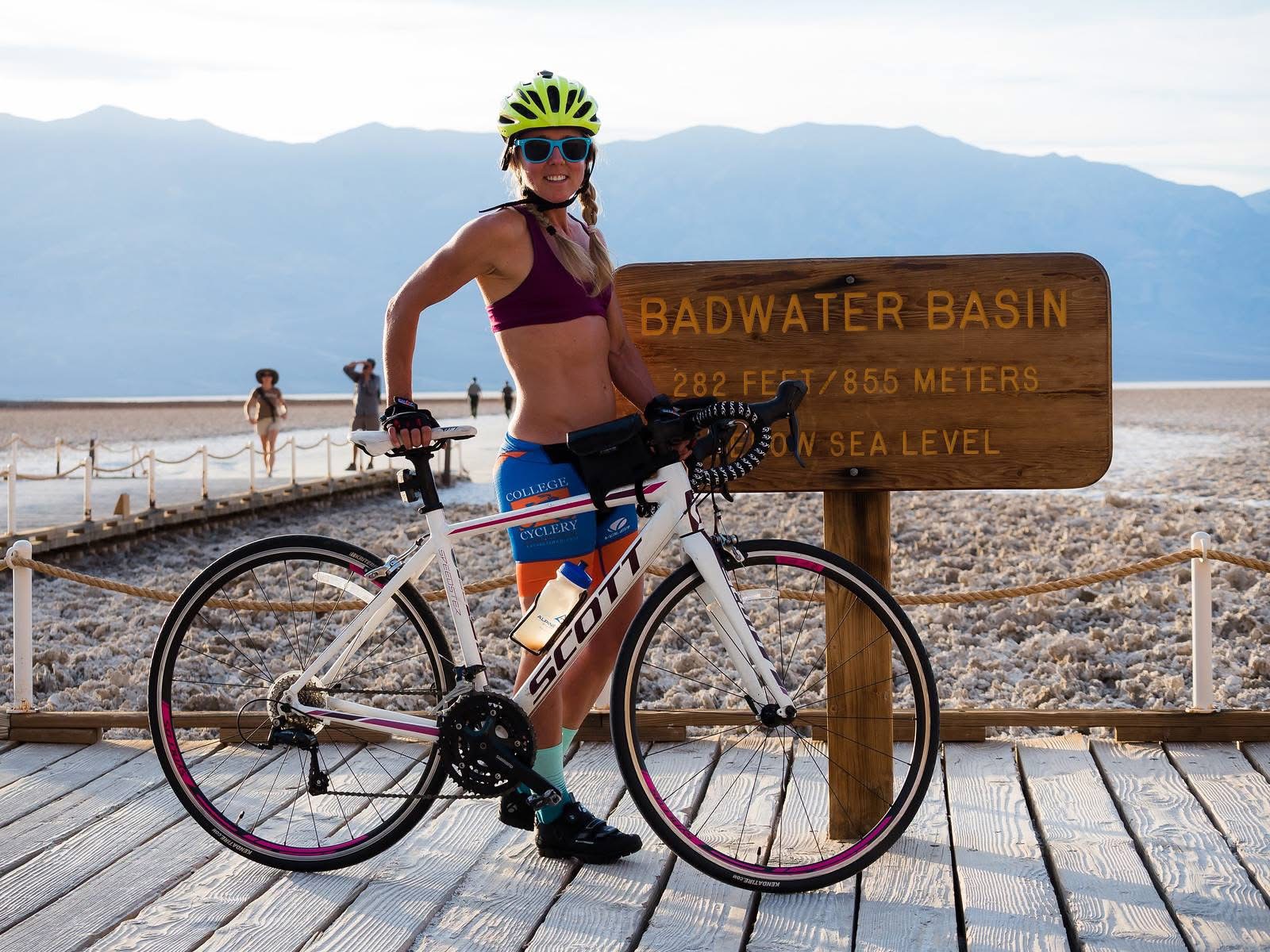
Roughly 132 miles by bike from Badwater Basin to Whitney Portal, then the Mountaineer’s Route to the 14,505-foot summit. The recovered modern clock starts with Don Bowie’s 19:35:16 in 2012 and 17:21 in 2013—before Ryan Tetz’s 14:42 and the Tetz–Bowie exchange of 2014. Separate women’s benchmarks followed in 2017 and 2019.

Contemporary report FKT / GPS documented Women’s progression
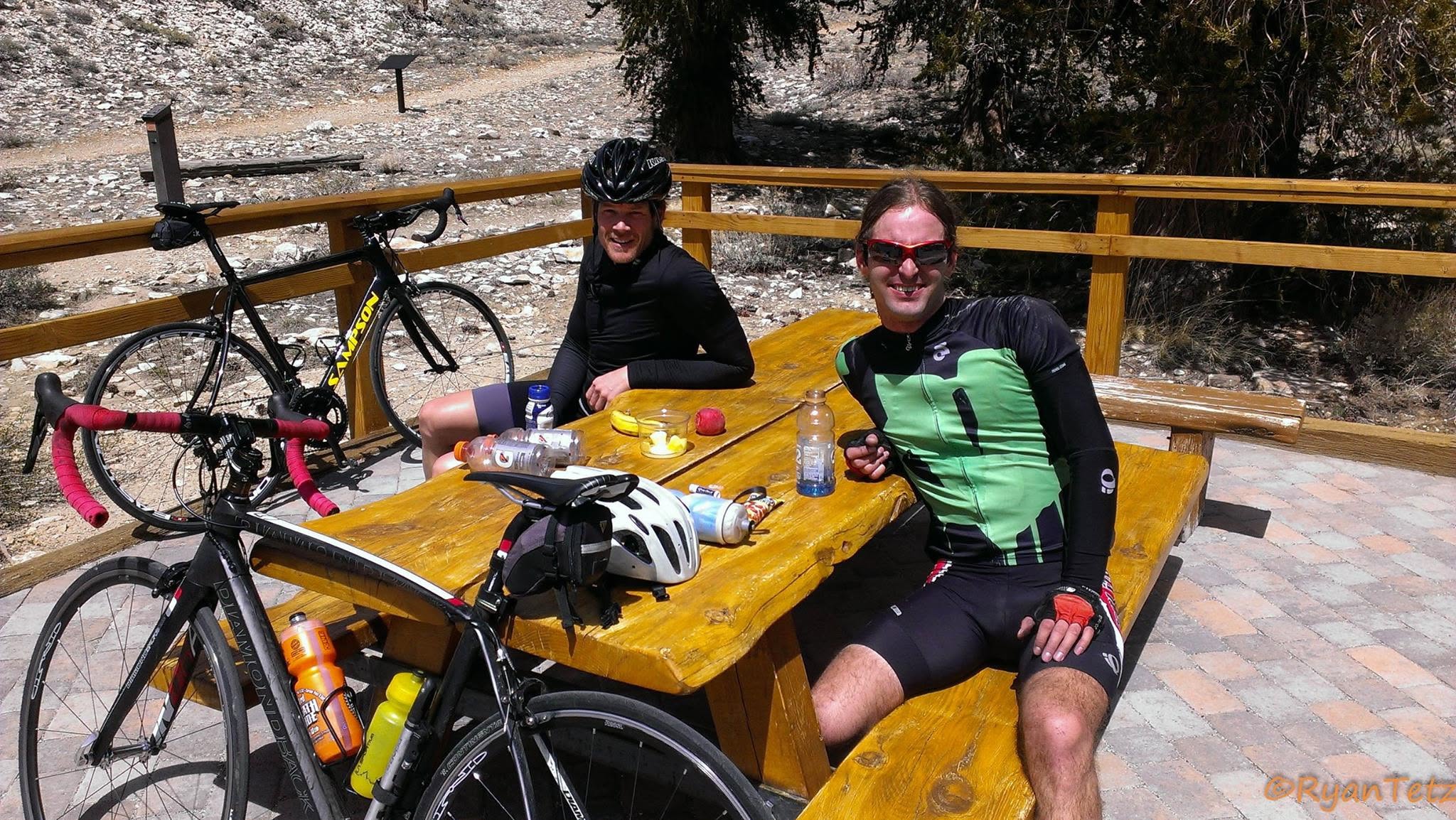
Don Bowie and Ryan Tetz seated beside their road bikes in November 2014
Don Bowie + Ryan Tetz · November 2014“Best friends or truly epic rivals?!”Photo from Ryan Tetz’s archive · posted eighteen days after Bowie’s 14:09:01 record
2013 / Don Bowie

ULTRA HURT.

17h 21m

Bowie’s film preserves the route before the later Tetz–Bowie exchange: the long desert bicycle leg, Whitney Portal transition and Mountaineer’s Route finish. His 2012 report gives a preliminary 19:35:16; this 2013 outing moved the modern line forward again.

Watch on Vimeo ↗Read Bowie’s 2012 account ↗
2019 / Current listed men’s supported markRyan Tetz · 13:16:0732-second PJAMM Cycling edit · published with permission
Tina Lewis stands with her bicycle beside the Badwater Basin sign2017 / First listed women’s completionTina Lewis · 23:27:21Rylee Sweeney rides through the Owens Valley during Badwater to Whitney2019 / Current listed women’s markRylee Sweeney · 21:36:00

THREE CURRENT
CATEGORIES.
NOT ONE CLOCK.

The standard traverse runs roughly 32 miles with 13,000 feet of gain between the Barcroft gate and Queen Canyon saddle. Support, direction and mandatory summits matter—and Todd Vogel’s Black Canyon extension is a fundamentally longer route.

Standard traverse32 mi · 13,000 ft

Barcroft gate ↔ Queen Canyon / Trail Canyon saddle

Open categoryNo women’s time currently listed

This identifies a public-record gap—not an assertion that no woman has completed the line.

Open the current FKT table ↗
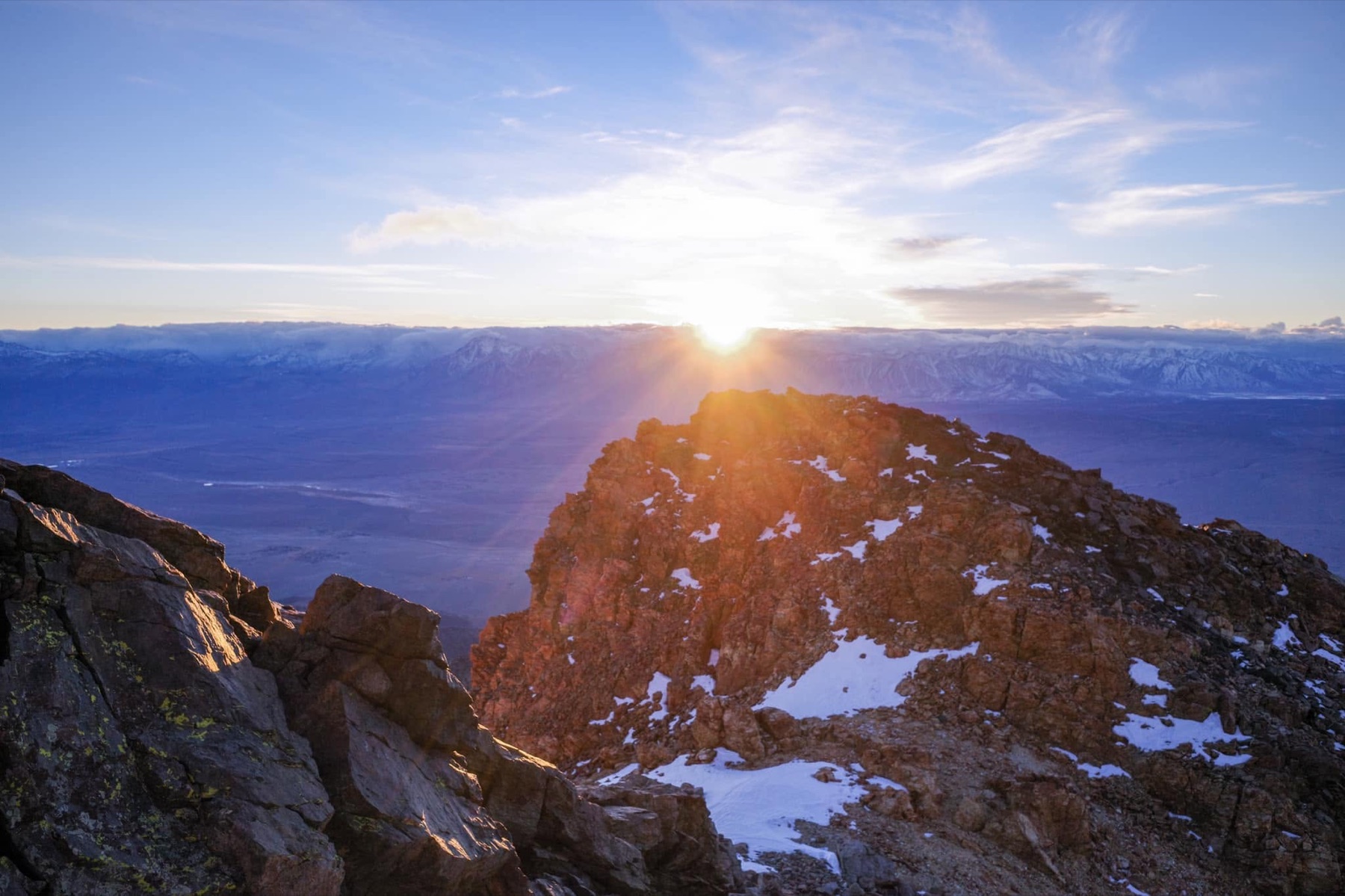
The sun rises across Owens Valley from a rocky White Mountains summit ridge
Sunrise across Owens Valley · White Mountains · Tetz archive

LAUREL’S
REGISTER-TO-GPS
LINEAGE.

The FKT route is the 3.1-mile, 4,200-foot Northeast Gully ascent from Convict Lake—a class 4–5 line first climbed by John Mendenhall and James Van Patten in 1930. Northeast Gully and Mendenhall Couloir are names for the same principal line. What differs in the old history is the clock: the current table records ascent-only efforts, while Ryan Boyer reports 1:27 to the summit and 2:12 car-to-car.

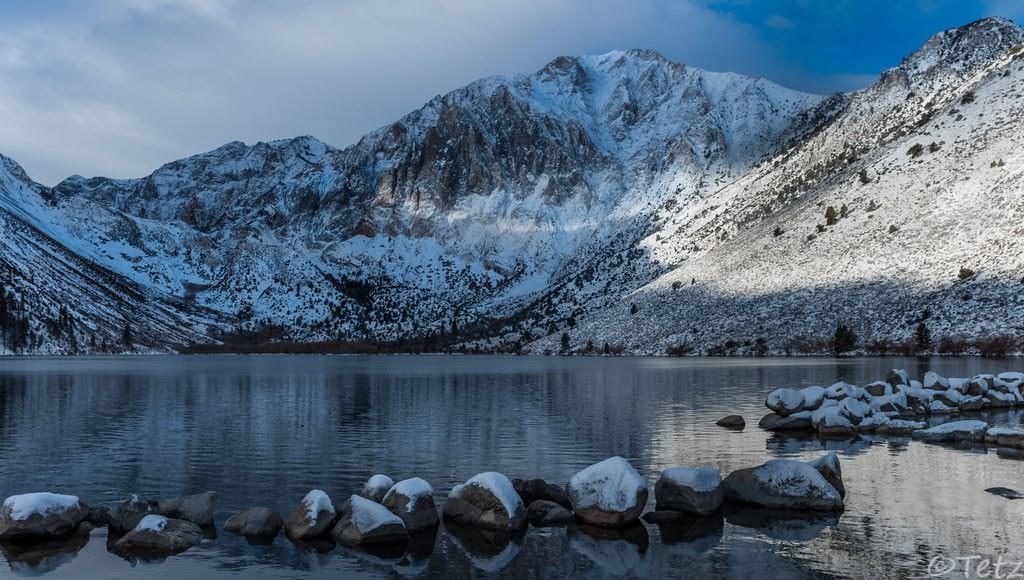
Snow-covered Mount Laurel rises above Convict Lake under broken clouds
Mount Laurel above Convict Lake after snowfallRyan Tetz archive · original watermark retained
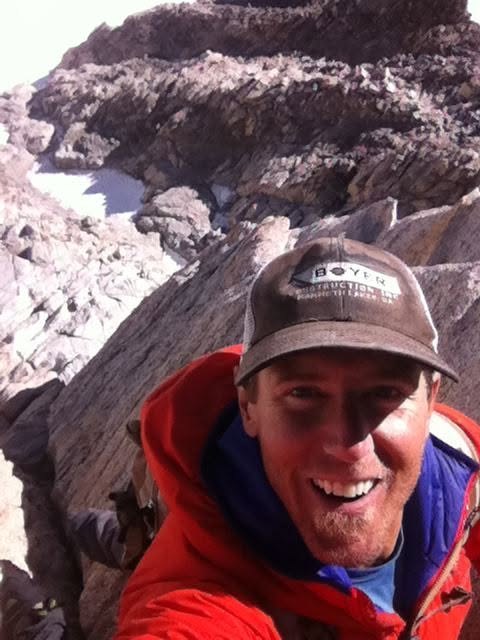
Ryan Boyer smiles for a selfie among pale alpine granite
Ryan Boyer · field portrait supplied by Ryan Tetz
Same route · separate clockRyan Boyer · 1:27 summit / 2:12 car-to-car

Boyer says he photographed the summit clock but carried no GPS during the Mendenhall effort, part of a friendly speed rivalry with Peter Clark. Jed Porter’s ledger independently preserves the 2:12 round trip. The exact date and start landmark still need recovery.

Open the current Laurel FKT table ↗
Crystal · Emerson · Laurel

THE CLOCKS,
NOT JUST
THE WINNERS.

Laurel’s full ascent lineage sits above. Crystal Crag and Mount Emerson belong beside it: short enough to invite repeated attempts, technical enough that course definitions and endpoint changes can move the story by minutes.

Competitive local line

Crystal Crag North Arête

Lake George pavement-to-pavement · true south summit required
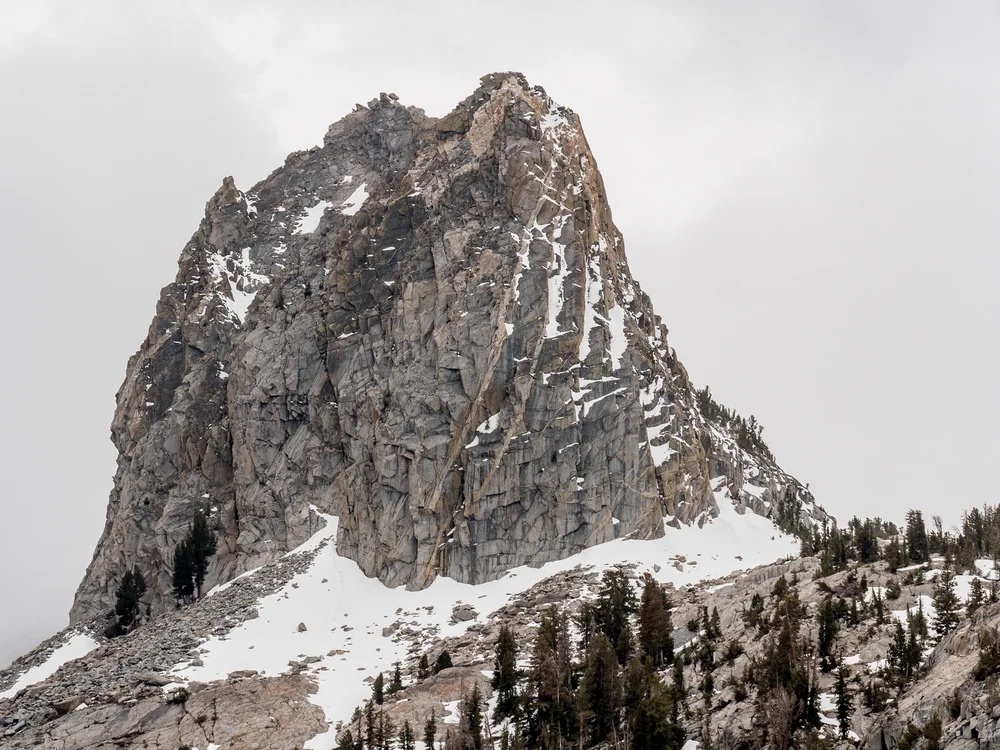
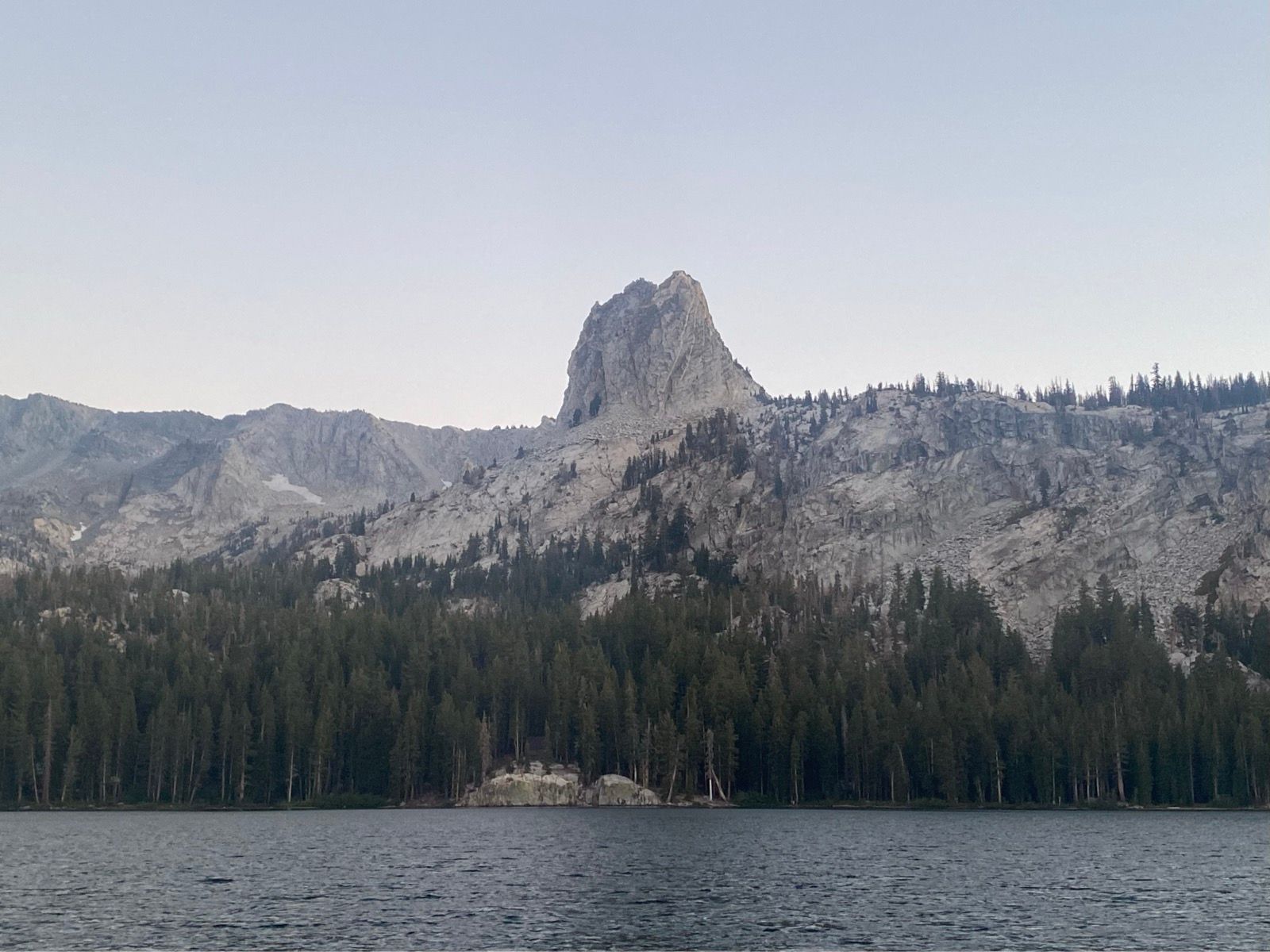
Crystal Crag rises above the Mammoth Lakes basin with snow streaking its dark north face
Crystal Crag in winter · photograph supplied by Ryan Tetz

A 2.26-mile run-and-scramble with 1,252 feet of gain and climbing to 5.6. The approach and descent invite creative route-finding, but the North Arête and true south summit define the test. Boyer’s oral history points farther back to undocumented Peter Croft speed in the late 1980s or early 1990s, while the old house, Clocktower and Crab Cooker variations remain separate Mammoth linkups rather than comparable course records.

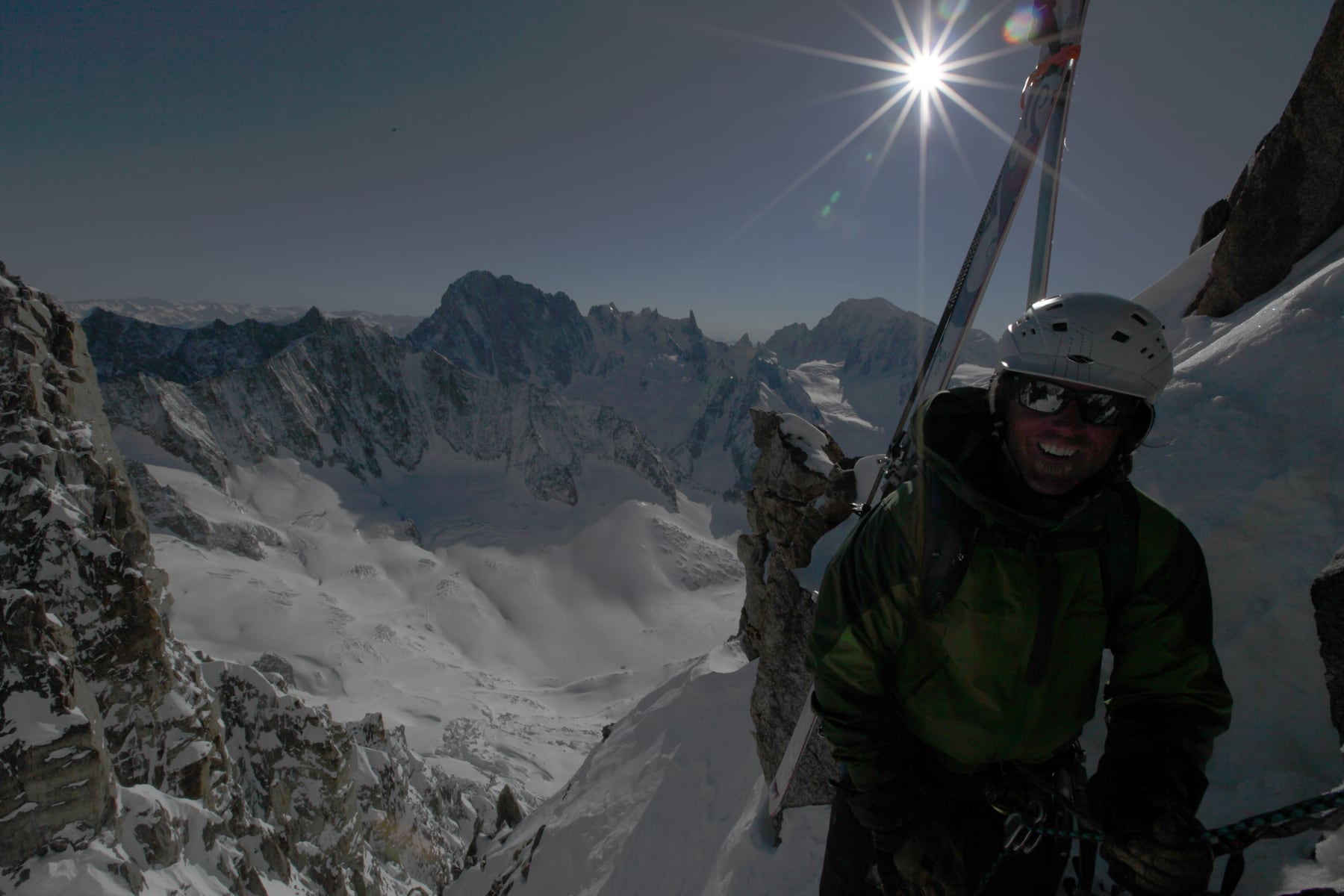
Ryan Boyer smiles with skis on his pack at a snowy alpine col above the Argentière basin
Ryan Boyer at the Angelique col · 2012 Chamonix outing · published by Cedric Bernardini; not the Crystal Crag effort
Pre-201455:00

Ryan Boyer

Jed’s ledger · separate early benchmark · date unrecovered

The first exact local benchmark preserved in Sierra Speed.

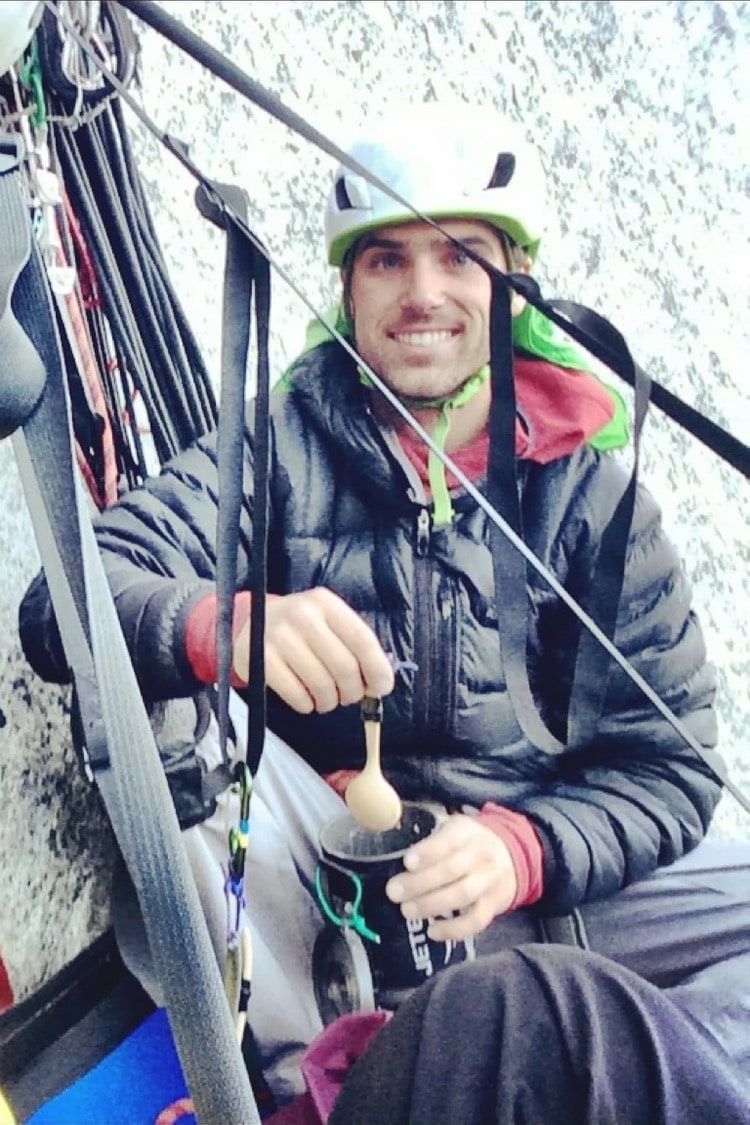
Josh Dibble smiles from a hanging bivouac on El Capitan
Josh Dibble · photograph by Cody Tuttle · athlete portrait; not the Crystal Crag outing
201448:32

Josh Dibble

Reported benchmark · endpoints unverified

The FKT route narrative preserves this 2014 clock, but the original start, finish and track have not been recovered. Ryan recalls that a possibly separate Josh effort may have started near the bridge; that recollection remains unverified.

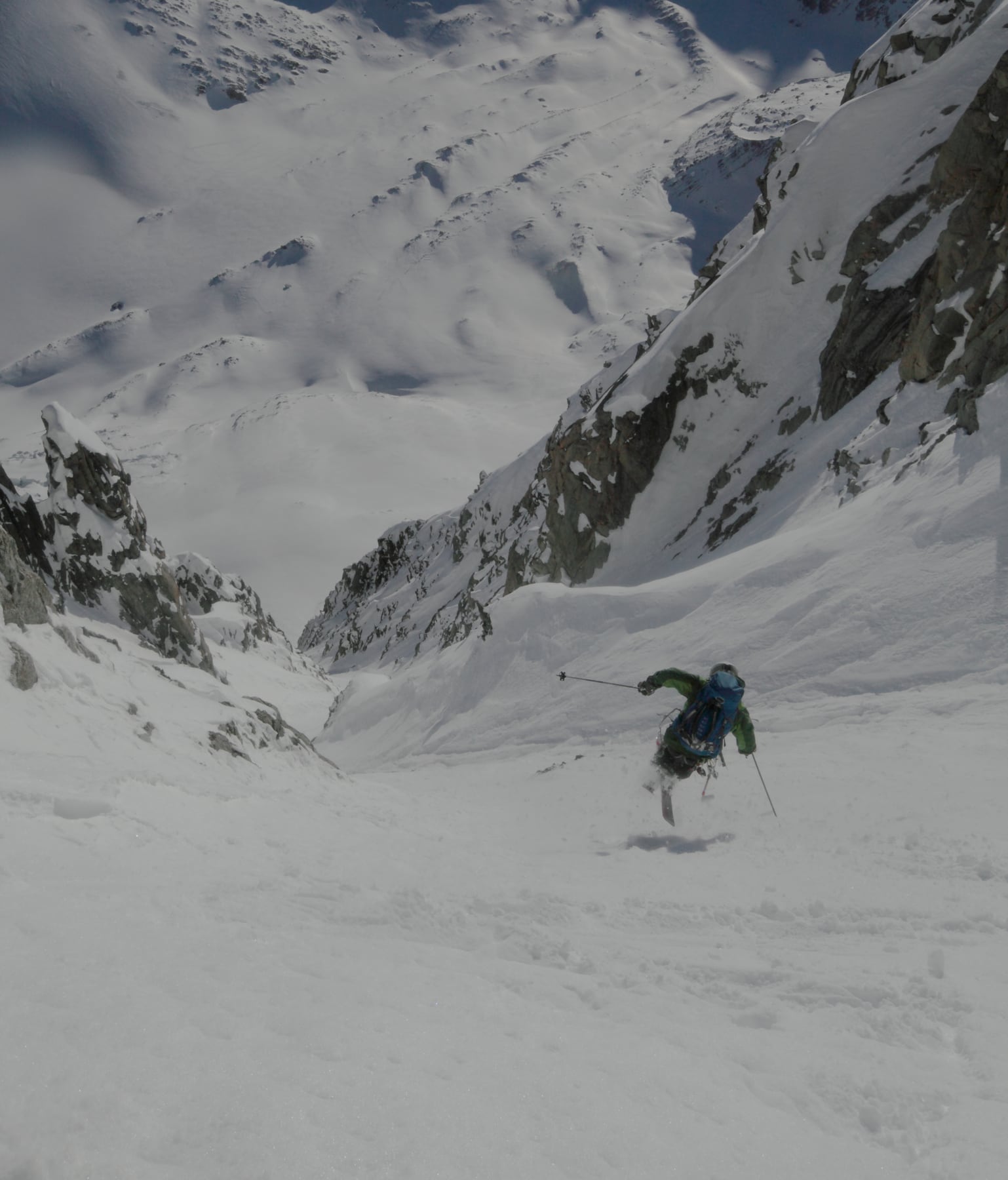
Ryan Boyer jump-turns down the steep snowy Angelique couloir in Chamonix
Ryan Boyer skiing the Angelique · 2012 Chamonix outing · published by Cedric Bernardini; not the Crystal Crag effort
After 201447-min range

Ryan Boyer

Boyer message · exact seconds, date and start unrecovered

Boyer described 47 minutes car-to-car, approaching by trail before going straight up and down the ridge. It remains local history rather than an official pavement-standard entry.

Ryan Tetz smiles in a helmet on the Mount Sill to Thunderbolt section of the California fourteeners
202047:38

Ryan Tetz

Unsupported · GPS documented

The first performance carried in the official FKT table.

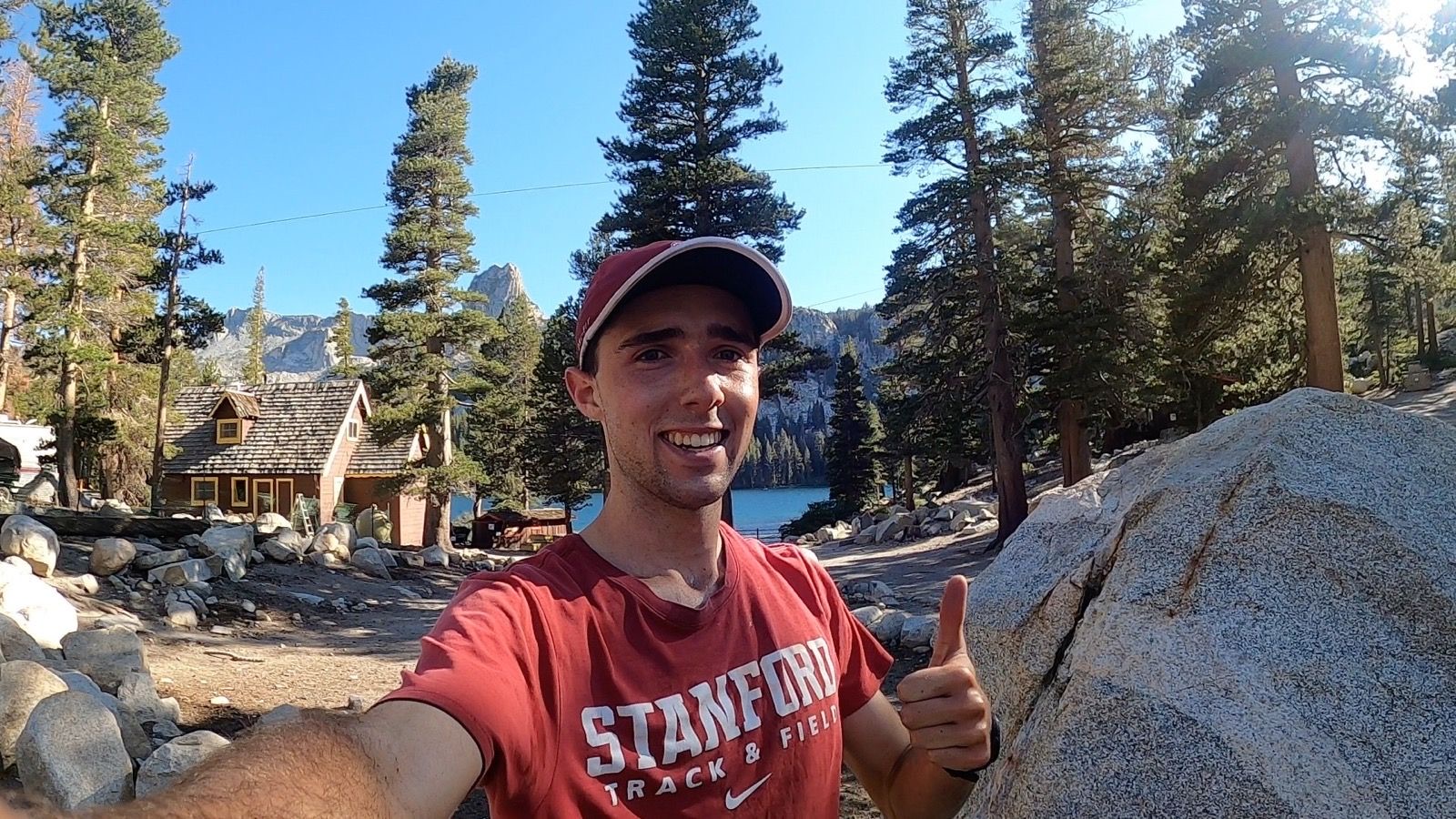
Meikael Beaudoin-Rousseau smiles at Lake George with Crystal Crag rising behind him
202144:25

Meikael Beaudoin-Rousseau

Unsupported · official FKT

The official elapsed clock; his Strava segment registered 44:14.

Crystal Crag rises above Lake George in Dylan Doblar’s record-day photograph
202443:18

Dylan Doblar

Current listed men’s unsupported

28:54 to the true south summit; 43:18 pavement-to-pavement.

Open the route and current table ↗
Competitive local line

Mount Emerson

Waterfall Route round trip · original and modern endpoints
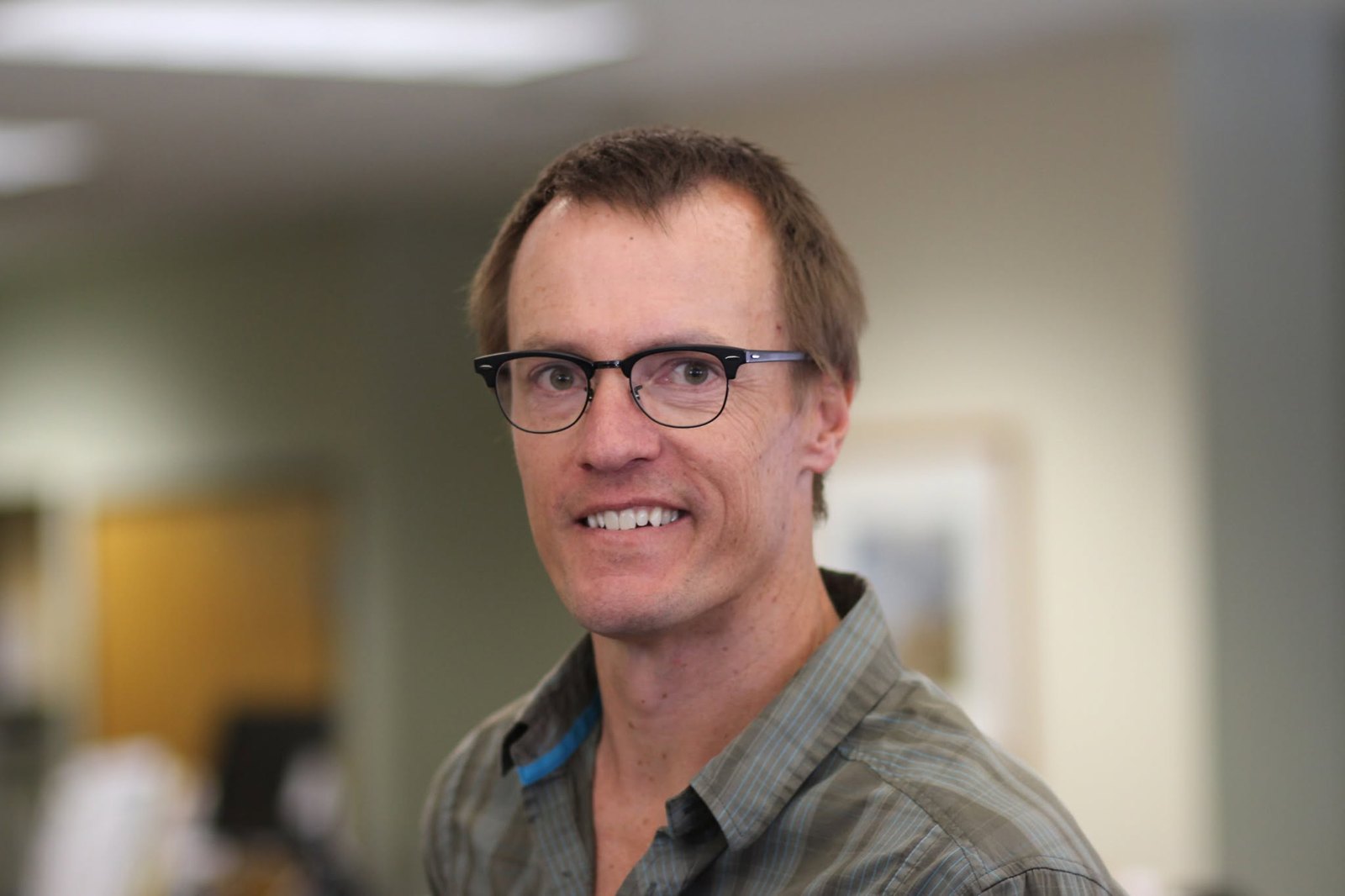
Peter Clark smiles for a head-and-shoulders portrait while wearing dark-framed glasses
Peter Clark · portrait supplied by Ryan Tetz · date and photographer credit to recover

The 7.2-mile, 4,000-foot front-country test climbs the Southeast Face / Waterfall Route and descends to North Lake. FKT’s 2022 route definition did not preserve Peter Clark’s original pack-station endpoint, so the historical and modern clocks are related but not directly ranked.

September 20143:31:02

Peter Clark

Pack-station parking lot round trip

Original longer-course benchmark. FKT later estimated that this endpoint added roughly five minutes each way, but that rough adjustment is not a timed split.

September 22, 20243:19:30

Goran Lynch

Current listed men’s unsupported · campground-sign course

The accepted FKT for the modern official course. Because it uses different endpoints, it sits beside rather than directly ahead of Peter’s original record.

Open the route and current table ↗
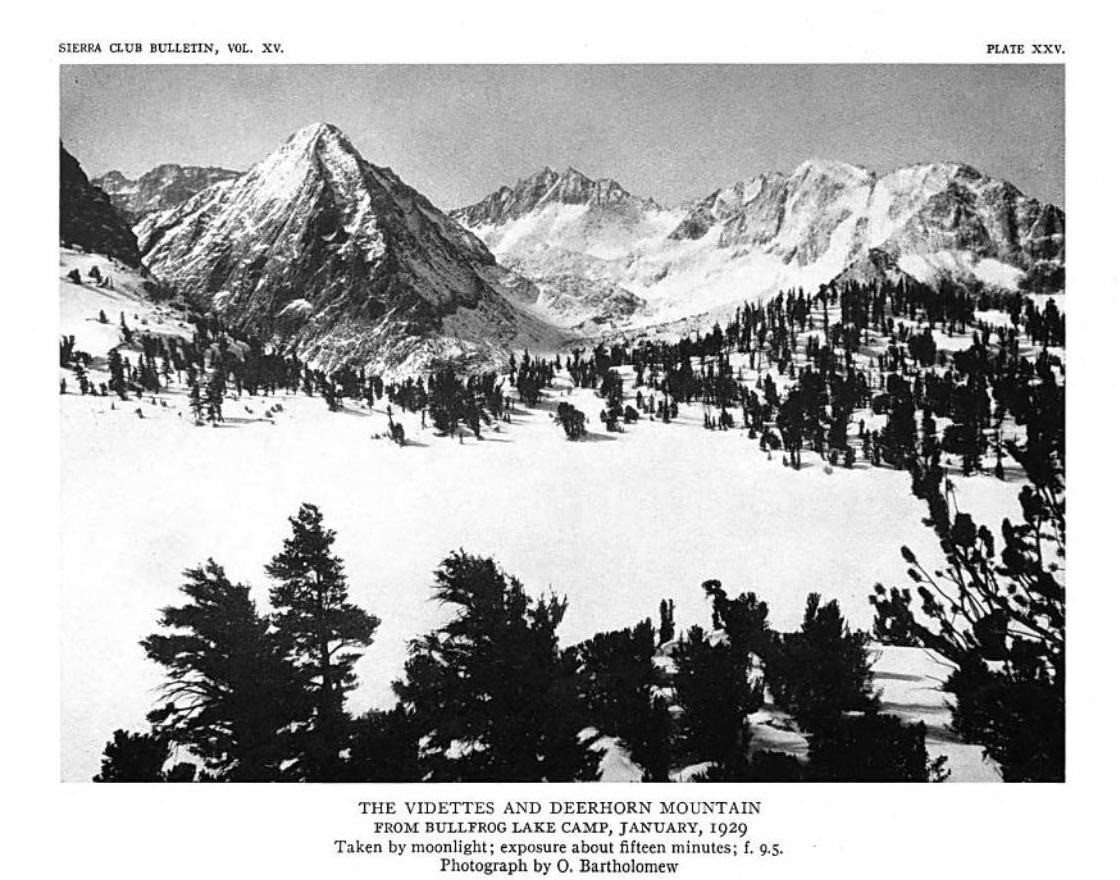
Snow-covered Videttes and Deerhorn Mountain above Bullfrog Lake Camp in January 1929, photographed by moonlight
Plate XXV · Sierra Club Bulletin, vol. XV · public domain scan

BEFORE THE
LEDGERS.

On Christmas Day 1928, Orland Bartholomew shouldered a roughly seventy-pound load and set out alone from south of Mount Whitney. For more than three months he moved north on wooden skis toward Yosemite, made the first winter ascents of Whitney, Langley and Tyndall, and carried a folding-bellows camera through the entire expedition.

This moonlit view of the Videttes and Deerhorn Mountain from Bullfrog Lake Camp is Bartholomew’s own evidence: an exposure of about fifteen minutes made in January 1929. His 1930 Sierra Club Bulletin account and photographs entered the U.S. public domain in 2026.

Andy Hyslop takes a field selfie in dry mountain terrain
Andy Hyslop · field portrait supplied by Ryan Tetz · date, location and photographer unconfirmed
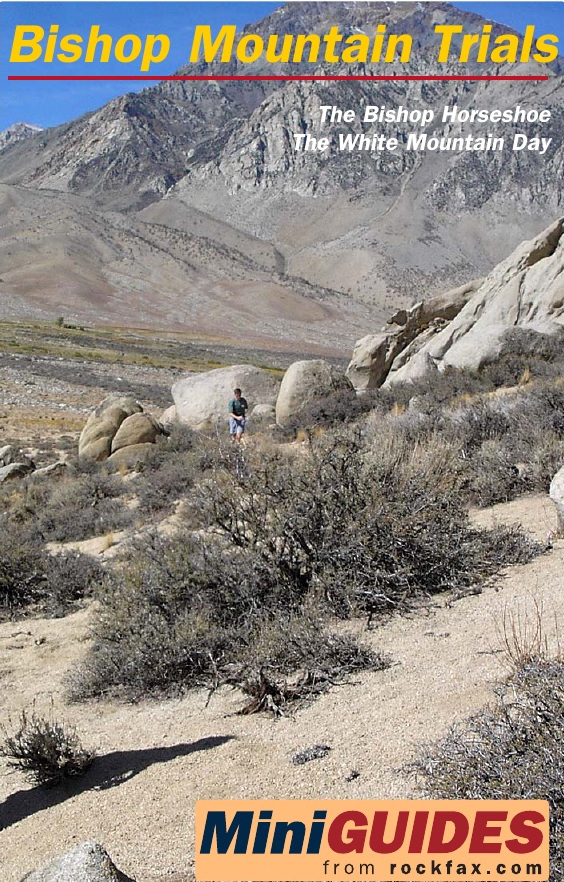
Cover of the 2003 Bishop Mountain Trials MiniGuide by Andy Hyslop
Bishop Mountain Trials MiniGuide · Andy Hyslop · Rockfax · October 2003

BISHOP
MOUNTAIN
TRIALS.

In 2002 British climber and runner Andy Hyslop completed and documented two audacious but entirely separate circuits. Rockfax published them the following year as “Mountain Trials”—one-day tests of speed, stamina, navigation, scrambling and technical rock. Their fixed routes, checkpoints and elapsed clocks make them unusually early published FKT-style benchmarks for Eastern Sierra technical mountain travel, although the guide never used that later term or made a record claim. Mick Ryan wrote the introduction and co-designed the MiniGuide; Hyslop was the athlete and route author. Ryan Tetz’s 2021 Bishop Horseshoe provides a GPS-documented modern return to one of those original lines.

A separate 2001 Hyslop–Jonathan Lagoe outing belongs here as anecdote, not in the record ledger. Lagoe climbed the first twelve California fourteeners then legally open before tendonitis ended his effort; Hyslop continued over Split Mountain and Shasta, completing fourteen peaks in fourteen elapsed days while Williamson was seasonally closed. The project used a hire car and a paid local lift, and faster fourteeners records already existed, so it is completion history rather than a record claim. Read Hyslop’s account ↗

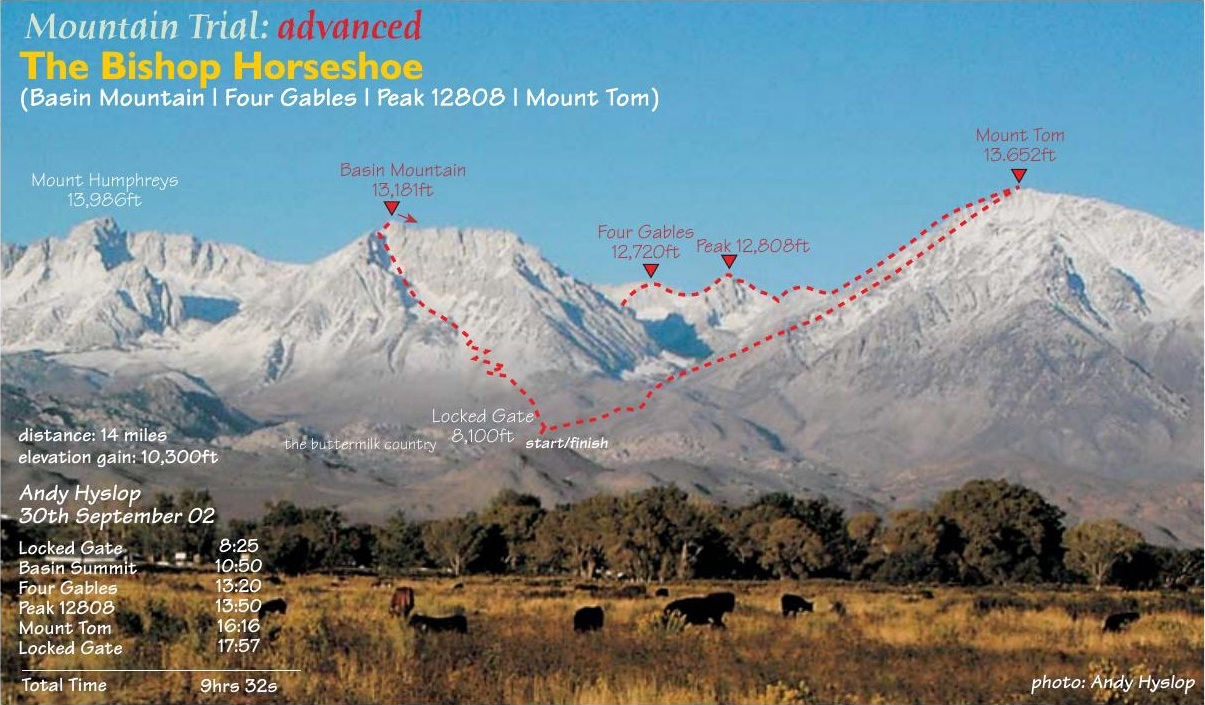
September 30, 20029:32

The Bishop Horseshoe

Basin → Four Gables → Peak 12,808 → Mount Tom

14 mi reported · 10,300 ft · locked gate round trip

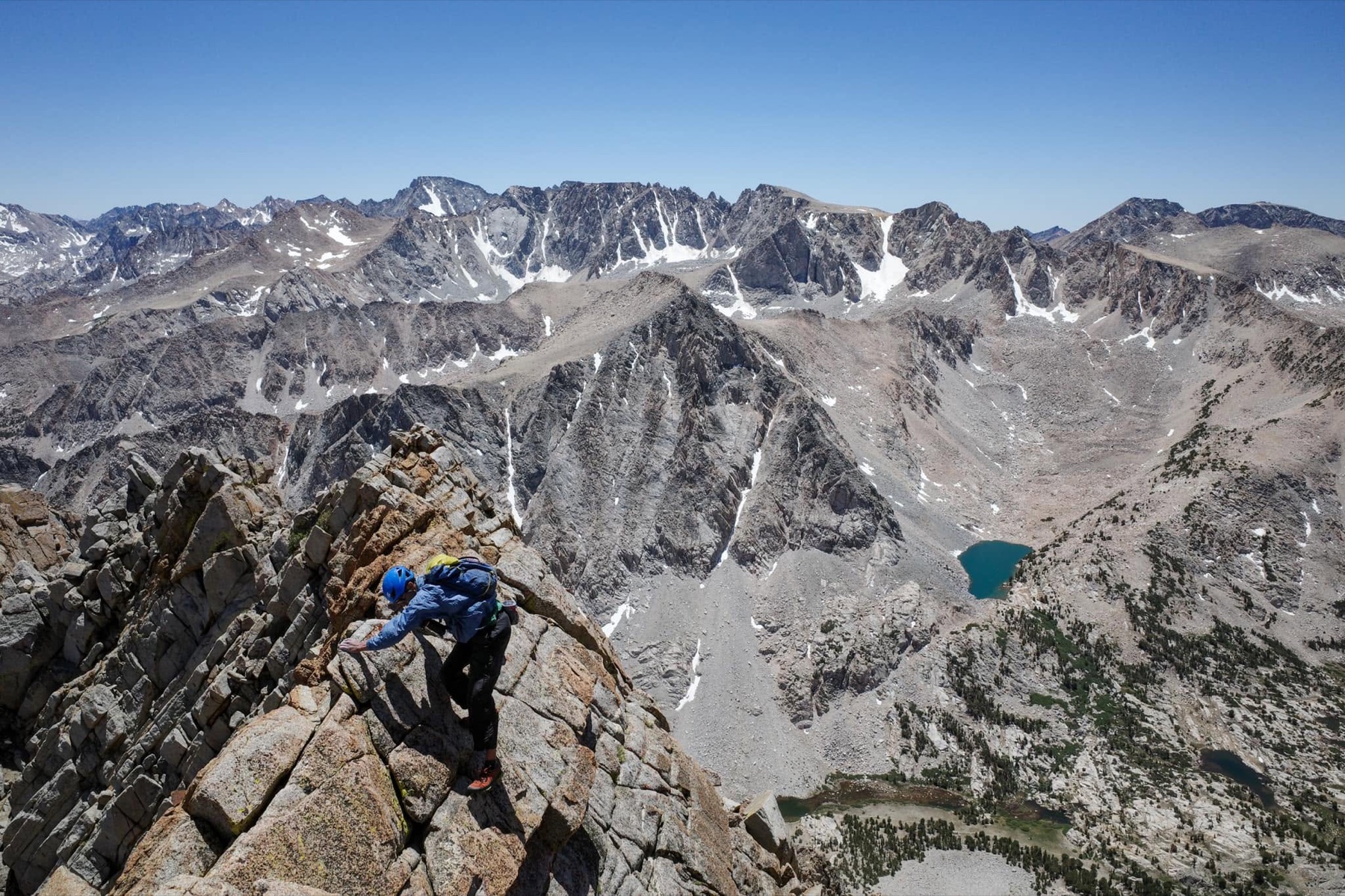
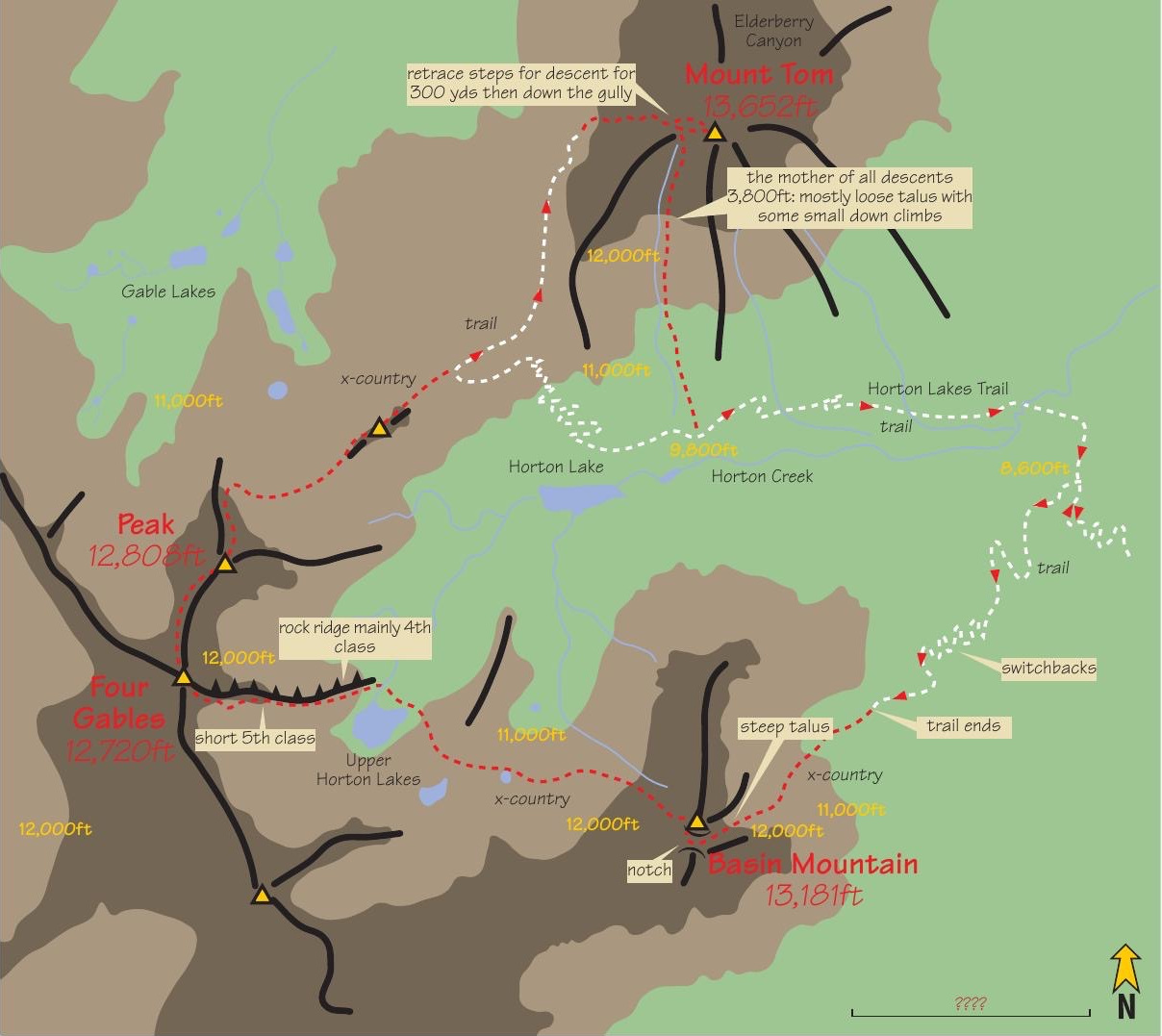
Andy Hyslop started at 08:25 and returned at 17:57. His published splits were Basin 10:50, Four Gables 13:20, Peak 12,808 at 13:50 and Mount Tom 16:16. The circuit includes fourth-class ridge travel and a short fifth-class section on Four Gables.

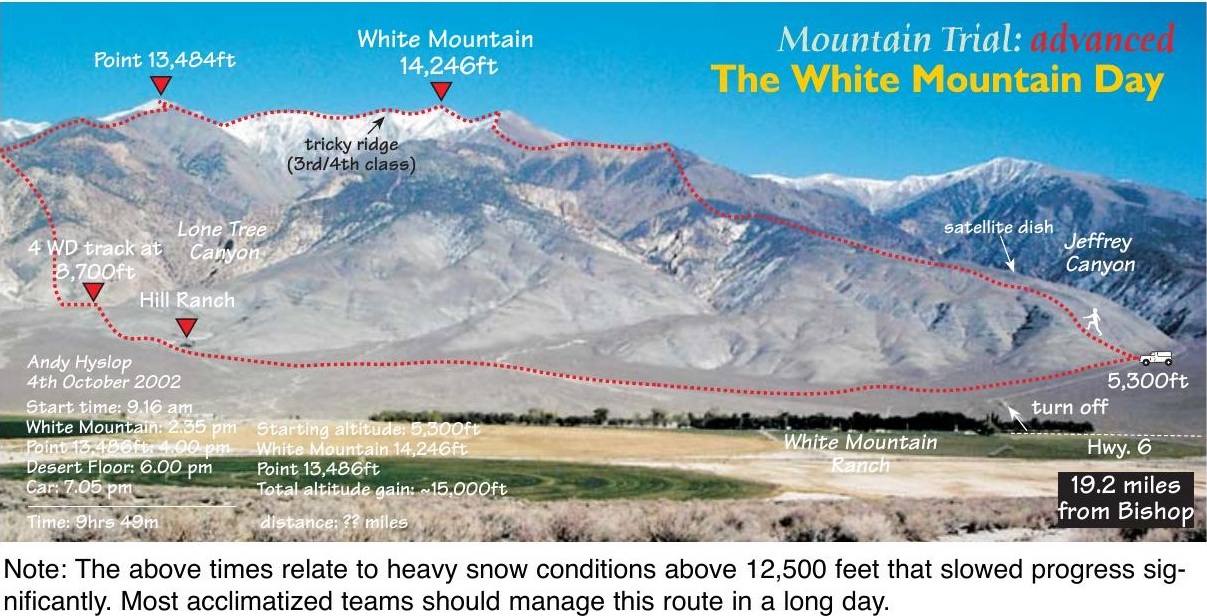
October 4, 20029:49

The White Mountain Day

Desert floor → White Mountain → Point 13,484 → desert floor

Distance unrecorded · ~15,000 ft · car round trip

Hyslop left the car at 09:16, reached White Mountain at 14:35 and Point 13,484 at 16:00, hit the desert floor at 18:00 and returned at 19:05. Heavy snow above 12,500 feet reportedly slowed the high ridge.

Documented modern completion11:47:37

Ryan Tetz

August 2, 2021

15.46 mi · 10,617 ft · 11:47:33 moving

Tetz’s first full Bishop Horseshoe followed the historic Basin–Four Gables–Mount Tom challenge and was recorded continuously on Strava. His August 29 retrospective called it roughly 90 percent off trail and credited Michael Ryan and Andy Hyslop for preserving the line.

What the source proves

The original checkpoint clocks, route definitions and Hyslop’s authorship. Neither performance is labeled an FKT, and neither source states a partner or support style.
Why they belong

These 2002 checkpoint clocks may be among the earliest published FKT-style benchmarks in the Eastern Sierra, while remaining two distinct routes with incomplete style documentation.

Why the MiniGuides disappeared ↗
Separate trail-running lineage

BISHOP
“SKY MARATHON.”

The Sky Marathon is the roughly 24-mile point-to-point trail classic between North Lake and Pine Creek: Piute Pass, Piute Canyon, French Canyon and Pine Creek Pass. Northbound and southbound reverse the same corridor, but climb and descent very differently. It shares neither the course nor the chronology of Hyslop’s Mountain Trials.

Men · unsupported

20224:34:24

Canaan Vallejos

20244:23:53

Josh Chartier

20253:58:36

Matt Zupan

Current listed

Women · unsupported

20236:22:30

Sapphire Stoner

20235:28:43

Sara Aranda

20245:02:01

Dani Moreno

20254:45:26

Kiana Ramli

Current listed

Women · supported

20254:49:52

Dayna Stimson

Current listed
Kiana Ramli smiles on a granite summit above the Sierra high country
Kiana RamliCurrent listed women’s unsupported Bishop Sky Marathon · 4:45:26 · photograph by Ryan Tetz
Before the public table · oral historyJason Lakey · early single + continuous double

Ryan Tetz remembers Lakey first completing the point-to-point Sky Marathon and, in another effort, running the full corridor out and back by reversing it at the far trailhead without stopping. The original dates, elapsed times, directions and exact endpoint landmarks have not yet been recovered.

Open the current Sky Marathon table ↗
Four names, four courses

The Bishop Horseshoe is Hyslop’s Basin–Four Gables–Peak 12,808–Mount Tom circuit; the White Mountain Day is his desert-floor White Mountain–Point 13,484 circuit; the Bishop Sky Marathon is North Lake–Pine Creek; and the modern White Mountain West Ridge is a separate out-and-back. None of their clocks transfer between courses.

WOMEN WHO
MOVED THE LINE.

Women have established enduring Sierra benchmarks across winter crossings, technical ridge traverses, continuous fourteeners projects and fast high routes. Some were first women’s completions; others reset an existing line or opened a new category.

Routes with a real lineage

First known efforts, historic steps and current marks are kept together. Style and route variation stay attached to the clock.

Foot · premier route1982 → 2026

Nüümü Poyo / JMT

Nicki Lewis finished with the 1982 supported group in 5d 16h. In 2004 Catra Corbett completed a pioneering JMT yo-yo in 12d 4h 58m, with a 5d 15h 50m first leg; the official history classifies the trip as resupplied (self-supported). Sue Johnston’s decade-long women’s mark, Darcy Piceu and Amber Monforte carried the line forward. Caroline Himbert now holds the unsupported northbound mark at 3d 16h 36m 15s; Monforte holds southbound at 3d 22h 55m 59s.

FKT chronology + yo-yo history ↗Himbert’s 2026 effort ↗
Alpine · women + mixed9D 12:17 → 6D 04:05

California Fourteeners

Jacqueline Florine made the first women’s continuous project on the 14 then-legal peaks in 2006. Andrea Sansone and Andrew Hamilton linked all 15 as a mixed team in 7d 11h 22m in 2017; Renee Elsdon Jacobs completed every climbing leg solo and set the listed women’s supported benchmark in 2019. Olivia Amber added the first women’s Norman’s 13 in 3d 17h 55m 48s in 2025.

Fourteeners lineage ↗Amber’s Norman’s 13 ↗
Foot · route variants30:00 → 19:30:45

High Sierra Trail

Marcia Rasmussen documented a 30-hour solo crossing without Whitney in 2007. Caitlin Roake and Felice Kelly established the first women’s-team time with Whitney in 23:55 in 2018; Marie VanZandt now holds that variant at 19:30:45 unsupported. The two courses stay separate.

Route chronology ↗VanZandt’s current mark ↗
High routes · foot + ski4D 23:53 / 2D 01:44

Two Sierra High Routes

Renee Elsdon Jacobs completed Roper’s roughly 195-mile, mostly off-trail Sierra High Route north-to-south in 4d 23h 53m in 2020. Michelle Campeau and Lexi Arlen established the first listed women’s Skier’s Sierra High Route in 2d 1h 44m unsupported in March 2026.

Jacobs on Roper’s route ↗Campeau + Arlen ↗
Technical ridge · unsupported12:32:16

Evolution first + Saber Ridge

Michelle Peot made the first reported female—and solo—completion of the technical Evolution Traverse in August 2011; her exact elapsed time still needs recovery. Isabel Reback’s 2022 Saber Ridge benchmark is fully clocked: 33.77 miles, 9,042 feet and a long 5.7–5.8 ridge, trailhead to trailhead.

Evolution ascent history ↗Saber Ridge ledger ↗
Eastern Sierra · distinct courses4:15:47 / 4:29:22

Whitney Portal records

Patricia Franco’s 4:16:37 in 2018 anchored the class-4 Mountaineer’s Route lineage before Alyssa Clark lowered it to 4:15:47 on July 29, 2026. Two days later Helen Mino Faukner reset both women’s Whitney Trail marks: 2:36:59 up and 4:29:22 car-to-car.

Whitney route table ↗Franco’s effort ↗
Owens Valley · unsupported14:06 → 9:04:41

White Mountain West Ridge

Sunny Stroeer and Libby Sauter opened the listed women’s progression in 2021. Ariane Arndt and Erin Ton lowered it before June Watterson ran the nearly 10,000-vertical-foot valley-to-summit round trip in 9:04:41 on April 6, 2026.

Full route progression ↗Watterson’s 2026 effort ↗
Mixed-team records23:56 / 16:27:23

Yosemite Picnic + Evolution Loop

Laura Pineau and Brian Ludovici completed the full bike–swim–climb Yosemite Picnic self-supported in 23:56 in 2025. Lindsay Gucker and Nick Schley hold the listed unsupported mixed-team mark on the 55-mile Evolution Loop at 16:27:23.

Yosemite Picnic table ↗Evolution mixed team ↗
Mixed-team ski expeditions50 MI / 24,000 FT

Jenna Kane + Greg Cunningham

Kane and Cunningham crossed the Great Western Divide from Mineral King to Onion Valley in winter conditions in 2021 on a new or previously undocumented ski line. In 2023 they spent 19 days on a 145-mile Redline interpretation with more than 80,000 vertical feet, 28 ski lines and 15 summits—a major documented mixed-team benchmark, without claiming an unverified first.

Great Western Divide ↗Redline history ↗

51 PEAKS.
ONE CLOSED
CIRCLE.

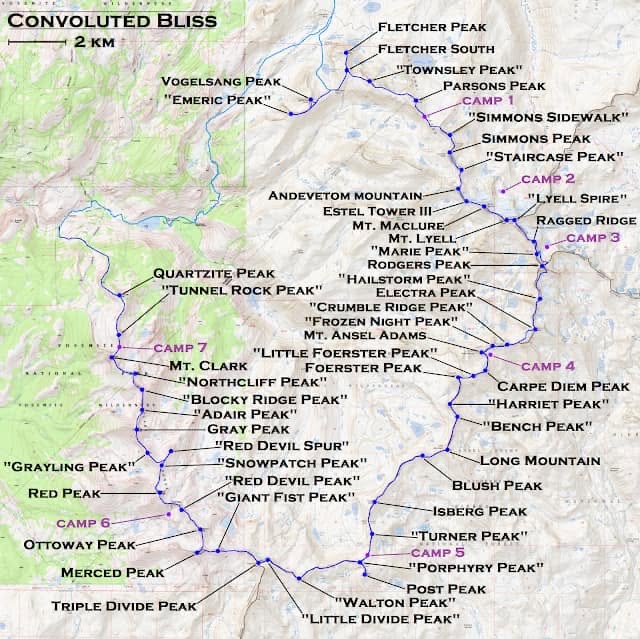
Convoluted Bliss closes a giant arc around Yosemite’s Merced Lake drainage: the Cathedral Range, Isberg Divide and Clark Range joined by more than 40 miles of ridge. The published route crosses 51 summits over a minimum 68.1 miles and roughly 27,000 feet of gain, mostly class 2 with short sections through fifth class.

51peaks
68.1minimum miles
40.1ridge miles
3d 12:47:07current listed FKT
01 / First ascent · August 3–10, 2017EIGHT DAYS

After an unsuccessful 2015 attempt, the first-ascent team returned in 2017 and completed the line over eight days. Their detailed account records 69.5 miles and 27,220 feet when camps and water detours are included.

02 / Second ascent · June 29–July 2, 20223d 12:47:07

Ryan Tetz, Vitaliy Musiyenko and Jason Hardrath left with four days of food and one cached resupply. At camp with 31 of 51 peaks behind them, Ryan wrote that it had been a strong start—and that the days were long. They closed the route July 2: the second ascent and current listed self-supported FKT.

Full field filmConvoluted Bliss ClimbEdited by Vitaliy Musiyenko · 32:51 · published August 1, 2022 · music credited to TOOL

Measurement note: The FKT route page gives the route standard as 68.1 miles and roughly 27,000 feet; the Klamath field post records the 2022 effort as 70 miles and 29,944 feet.

LINES & LINEAGE

Here, “record” means the current mark for that route and category in the linked public table. Older efforts may still be missing.
One crest / another season

Lakey established the complete crest as a single-push problem. Five years later, Jed Porter and Ian McEleney returned to make the traverse’s first winter ascent.

Jed Porter in a red jacket and orange helmet climbing exposed granite above the snowy Palisades
Jed Porter on the first winter Full Palisade Traverse · photograph by Ian McEleney · 2013

THE WINTER
FULL
PALISADE.

Clock4d 16h
GradeVI 5.9
High pointsSix 14ers
On the ridgeFour bivies

In late February 2013, Jed Porter and Ian McEleney left Big Pine Creek with 30-pound packs and committed to the complete Palisade crest. Beyond Southfork Pass, eight miles of exposed winter ridge linked steep snow, low-angle ice and rock to 5.9 across six fourteeners. Four bivouacs later, they returned to the trailhead having completed the first winter Full Palisade Traverse in 4 days 16 hours.

“Inspired by their accomplishment, we decided that if we had failed at our first objective we should probably pick something harder.”

Ian McEleney’s 2013 account ↗

“The challenge came from the sum of so many moves and pitches and peaks.”

Jed Porter, quoted in Alpinist 48 ↗

Their style was deliberate: no caches, a rope used sparingly, a small tent and a daily stop to melt water. This was the complete Southfork Pass–to–Bishop Pass traverse—not the familiar Thunderbolt-to-Sill link—and its place here is as a winter first ascent rather than a repeating speed record.

43 lines shown

01

Southern Sierra · Alpine

Norman’s 13

107.5 mi · 40,000+ ft · continuous

Andy Gohlich imagined the line. Ryan Tetz made the first complete crossing in 2019, Matt Zupan established the unsupported mark, Jason Hardrath the supported mark, and Kilian Jornet moved it forward again. Olivia Amber made the first women’s completion currently documented in the public route history in 2025.
Published sourceFull lineage ↗
02

Statewide · Alpine

California Fourteeners

15 summits · trailhead to trailhead

A rare long-running record: Hans Florine, Russ McBride and Tony Ralph in 1998; Josh Swartz; Jack McBroom; then Sean O’Rourke’s 62:03 in 2012. Jacqueline Florine set an early women’s benchmark on the then-legal 14 peaks; Renee Elsdon Jacobs later completed all 15. The human-powered history runs from Honnold and Wright through Sam Skrocke’s still-standing self-supported mark, then Ryan Tetz, Jason Hardrath and Kilian Jornet in the supported category.

Published sourceRecord history ↗
03

Mount Shasta → Southern Sierra · Multi-sport

Sam Skrocke’s Self-Powered Fourteeners

2014 · 15 summits · 642 bike mi · 9d 20h 41m

From July 29 to August 7, 2014, Sam Skrocke climbed all 15 California fourteeners and linked every trailhead by bicycle, starting on Mount Shasta and finishing back at his bike at Tuttle Creek after Mount Russell. He reported 642 cycling miles and 50,727 feet of bike gain while carrying all his gear plus all climbing and camping food from the start. He accepted no private aid and bought only ordinary restaurant meals during the cycling legs, so the official category is self-supported—not unsupported—although Skrocke described his ethic as ‘completely self-supported and mostly unsupported.’ The mountain standard was just as striking: six Palisade summits in one day, an onsight 5.9 variation on Thunderbolt, the 5.9 Palisades Traverse, and Russell’s Fishhook Arete onsight at the end. It remains the listed men’s self-supported, self-powered benchmark; the later faster bicycle-linked efforts belong to the supported category.

04

Pacific Ocean → California–Nevada line · Cycling

Trans-California Crossing Direct

320.1 mi · 27:20:22 reported · supported

On October 22–23, 2014, Ryan Tetz established the supported Trans-California Crossing Direct, taking a west-to-east bicycle line through Stockton, Oakdale, Old Priest Grade, Yosemite and Tioga Pass. James Nichols stayed through the entire crossing as the sole support crew. Ryan’s finish clock read 27:20:22 for 320.1 miles. The primary Strava file preserved 287.08 miles, 24,855 feet of gain and 25:18:02 elapsed before the GPS lost the final section; a separate 26-mile, 2:02 finish-credit activity documents part of the gap. Because those digital files do not perfectly reconstruct the finish note, this archive keeps 320.1 and 27:20:22 as Ryan’s contemporaneous reported totals—not a cleanly GPS-verified FKT. No later attempt on the exact line has yet been located; the precise Pacific and Nevada-border touchpoints still need Ryan’s confirmation.

05

Highway 395 ↔ 49 · three full Sierra crossings · Cycling

The Triple Sierra Crossing

309.42 mi · 28,494 ft · 26:32:35 elapsed

On July 8–9, 2019, Ryan Tetz established and claimed the first full triple Sierra crossing in any sport: three full road crossings of the range in one nonstop ride. He rode Highway 395 to 49 over Tioga Pass and Highway 120; Highway 49 back to 395 over Sonora Pass and Highway 108; then Highway 395 to 49 over Monitor and Ebbetts passes, finishing near Angels Camp. Strava preserves the full 309.42-mile track, 28,494 feet of gain, 22:41:38 moving and 26:32:35 elapsed. His rule set was one ride, no sleeping, and a Highway 49 or 395 touch after every crossing. The RV Project independently described it as the first known triple-Sierra bicycle crossing. The activity does not identify a crew, so support style remains undocumented.

07

Crescent Meadow ↔ Whitney Portal · Foot

High Sierra Trail

≈72 mi with Whitney · summit and direction matter

The practical trailhead-to-trailhead crossing links Crescent Meadow to Whitney Portal and includes Mount Whitney, although the named High Sierra Trail technically joins the JMT at Wallace Creek. FKT therefore keeps with-summit, without-summit and yo-yo variations separate. On the with-Whitney course, the current listed unsupported marks are Joseph Roldan’s 15:26:39 and Marie VanZandt’s 19:30:45. Earlier benchmarks include Marcia Rasmussen’s 30-hour solo without Whitney, Brian Robinson and Peter Bakwin’s 24:58, Brett Maune’s 18:38 and Leor Pantilat’s long-standing 15:46. Direction and intermediate Whitney splits belong beside every clock.

08

Road’s End → Twin Lakes · Foot

Sierra High Route

Roper’s line · ≈200 mi · 43,000 ft · mostly off-trail

Steve Roper’s Sierra High Route is a remote point-to-point line whose off-trail sections resist the certainty of a blazed trail; FKT directs athletes to follow Roper’s description rather than treating its public GPX as the exact course. Andrew Skurka and Buzz Burrell completed an early fast thru-hike in 8d 4h with a resupply in 2008. Brian Lucido opened the formal unsupported progression at 6d 13h 35m in 2015, followed by Leor Pantilat’s 4d 16h 21m and David Ayala’s current listed men’s unsupported mark of 4d 3h 36m. Renee Elsdon Jacobs holds the listed women’s supported benchmark at 4d 23h 53m.

09

Whitney Portal ↔ Happy Isles · Foot

Nüümü Poyo / John Muir Trail

223 mi · premier route · direction and style stay separate

For FKT purposes, the JMT / Nüümü Poyo runs pavement-to-pavement between Whitney Portal and Happy Isles, adding the eleven miles below Mount Whitney’s summit. There is no single JMT clock: northbound, southbound, two yo-yo directions and each support style have separate tables. Current headline marks include François D’Haene’s 2d 19h 26m supported and Aurelien Sanchez’s 3d 3h 55m 10s unsupported northbound times, and Jeff Garmire’s 3d 0h 47m 56s unsupported southbound time. The current listed women’s unsupported marks are Caroline Himbert’s 3d 16h 36m 15s northbound and Amber Monforte’s 3d 22h 55m 59s southbound. The official-route and pavement endpoints are essential to every comparison.

10

Whitney · Foot

Mount Whitney, Portal to Portal

Current men’s unsupported · Matt Dubberley · 2:38:15

Before GPS, the Portal Store was the timing desk. Marty Hornick and Jason Lakey established the witnessed lineage; Brett Maune and Andy Anderson moved it forward. On August 2, 2015, Matt Dubberley climbed in 1:47:40 and returned in 2:38:15—the current men’s unsupported Mountaineer’s Route car-to-car mark listed by FKT.

Published sourceCurrent listed FKT ↗
11

Death Valley → Sierra crest · Multi-sport

Badwater to Whitney Duathlon

139 mi · bike + Mountaineer’s Route

The Whitney Classic first carried the bike-hike idea from Badwater to the summit. Don Bowie’s recovered modern lineage begins with a preliminary 19:35:16 in 2012, followed by 17:21 in September 2013. Ryan Tetz and Bowie then traded the mark in 2014 before Tetz lowered it to 13:16:07 in 2019. Tina Lewis and Rylee Sweeney established the listed women’s progression.

Published sourceRoute & times ↗
12

Yosemite · Multi-sport

Yosemite Picnic

100+ mi · 88 mi bike / 2.2 mi swim / 10.7 mi climb

Ryan Tetz and Jason Hardrath created and completed the Yosemite Picnic in 14:36:50 in 2020. Starting at El Capitan Bridge, they bicycled 43.5 miles out of Yosemite Valley—climbing 6,500 feet—to Tenaya Lake. They swam the 1.1-mile length of the lake, ran and scrambled the Tuolumne Triple Crown, then swam back across Tenaya to their bicycles. Finally they bicycled the full 44.5 miles home to El Cap Bridge, finishing where they started. The two bicycle legs account for 88 miles and 8,900 feet of climbing: nearly the entire 100-mile linkup is framed by the ride up from the Valley and the ride home.

Published sourceRoute history ↗
13

Yosemite · Winter / ski

Yosemite Winter Picnic

2018 winter solo · 2022 spring team · 2024 spring solo

The Yosemite Winter Picnic bikes Tioga Road from the winter closure, skis to Cathedral Peak, climbs the peak, then reverses the entire course to the car. Ryan Tetz’s January 2, 2018 solo is preserved on Strava: 40.25 miles, 6,355 feet and 12:41:10 elapsed. On April 6, 2022, Tetz and Leo Franchi completed the line together in 12:57:57 elapsed, logging 40.42 miles and 6,220 feet. Jake Whisenant—who also held the Lurking Fear speed record on El Capitan and The Prow record on Washington Column—made the third known completion and second known solo on May 15, 2024 in 8:58:59 elapsed, with 40.12 miles and 6,808 feet. The 2018 outing falls in calendar winter; the April 2022 and May 2024 finishes are spring completions of the same bike–ski–climb line.

14

Evolution region · Alpine

Evolution Traverse

Current listed: Matthew Cornell · 15:21:29 unsupported

Peter Croft completed the first full traverse solo in 1999, first light to dark from camp. The separate trailhead-to-trailhead clock begins with Austin Siadak’s 23:58 in 2014, passes through Sean O’Rourke’s 17:42 in 2016 and Dylan Doblar’s 17:28:44 in July 2025, then reaches Matthew Cornell’s current listed 15:21:29 unsupported mark on August 21, 2025.

Published sourceRoute history ↗
15

Palisades → Evolution crest · Alpine

Goliath Traverse

32 mi of ridge · ~60 summits · eight days

From August 2–9, 2021, Vitaliy Musiyenko soloed the Sierra crest from Taboose Pass to Piute Pass, joining his new Full Monty extension of the Palisade Traverse with the Full Evolution Crest. He covered roughly 32 technical ridge miles and nearly 60 summits in eight days, with no support or preplaced caches.

16

Palisades · Alpine

Full / Complete Palisade Traverse

8 mi · 26 peaks · six fourteeners

Jason Lakey made the first accepted single-push completion of the eight-mile, Grade VI 5.9 full crest in 2008, accompanied through roughly halfway by Nathaniel Walker and Matt Ciancio. Later parties have completed the traverse, but no faster directly comparable strict-line single-push has surfaced in the recovered public record; Ryan remembers Lakey’s benchmark as still unbeaten. Its exact clock and rules remain missing. Michael Reardon reported a 22-hour solo in 2005, though later Sierra sources dispute whether he completed the full crux crest. This is the complete Southfork-to-Agassiz/Bishop line—not the shorter Thunderbolt–Sill classic.

17

Southeastern Yosemite · Alpine

Convoluted Bliss

51 peaks · 69 mi · 27,000 ft · 3d 12h 47m 07s

Ryan Tetz, Vitaliy Musiyenko and Jason Hardrath completed the second ascent and current listed FKT in 2022, circling the Merced Lake drainage car-to-car in 3 days, 12 hours, 47 minutes and 7 seconds. They traveled self-supported with one cached resupply, cutting the first-ascent team’s eight-day passage by more than half.

18

Yosemite high country · Alpine

Tuolumne Triple Crown

Tenaya · Matthes · Cathedral

The high-country loop joins Tenaya’s Northwest Buttress, Matthes Crest south-to-north and Cathedral’s Southeast Buttress. Its public progression runs from Jason Hardrath through Vitaliy Musiyenko, Christian Black, John Clark and Greg Horvath to Travis Soares’ 3:44:12 in 2021.

Published sourceRoute & comments ↗
19

Yosemite high country · Alpine

Mt. Conness Alpine Triple Crown

Current listed: Matt Zupan · 4:49 unsupported

This is the Mt. Conness variation—not the Tenaya–Matthes–Cathedral Tuolumne Triple Crown. It links the North Ridge of North Peak, the North Ridge of Mt. Conness and the West Ridge of Conness in one technical circuit. Meikael Beaudoin-Rousseau established a listed 5:01:30 in 2022; Matt Zupan lowered the unsupported mark to 4:49 on August 8, 2024.

Published sourceRoute & times ↗
20

Whitney · Alpine

Whitney Massif Five

5 routes · 5,500 ft technical climbing

On August 27, 2010, Jason Lakey free-soloed Keeler Needle, Whitney’s East Buttress and East Face, then Russell’s Mithril Dihedral and Fishhook Arete in approximately 16 hours 30 minutes car-to-car—48 pitches and about 5,500 vertical feet of technical climbing. Lakey described it as one of his most real, pure and proud mountain days. Despite its scale, it remains one of the era’s most underrepresented Sierra linkups in the recovered public record.

Published sourceAlpinist report ↗
21

Ritter Range · Alpine

Minaret Traverse

Sixteen summits · a three-day line became one

Vern Clevenger and Claude Fiddler completed the traverse in three days in 1982. Peter Croft brought it under a day in 1992; Josh Swartz reported 16:56 car-to-car in 2002. Jason Lakey’s later one-day chapter still needs its exact time and endpoints recovered.

22

White Mountains · Foot

White Mountains Range Traverse

Current listed: 11:25:37 supported · 11:43:32 unsupported

Jon Crowley and Jimmy Elam recorded an earlier 11:39. The current public table lists Jed Porter’s 2014 south-to-north 11:25:37 as supported and Sean O’Rourke’s 2020 north-to-south 11:43:32 as unsupported. Sean’s uphill version included Hogue and Peak 13,315; direction, summits and support make the marks separate categories.

Published sourceVariants & history ↗
23

Owens Valley → White Mountain · Foot

White Mountain West Ridge

Current listed: Sean O’Rourke 7:01:23 · June Watterson 9:04:41

Sean O’Rourke climbed from the radio-tower road near 5,280 feet to the 14,252-foot summit and returned in 7:01:23 in 2018; June Watterson lowered the listed women’s unsupported mark to 9:04:41 in 2026. Andy Hyslop’s 2002 White Mountain Day began near the same desert-floor toe of the ridge, but continued north over Point 13,484 and descended a different ridge before circling back to the car. It is an important ancestor, not the same out-and-back course.

24

Convict Canyon · Alpine

Mount Laurel Northeast Gully

Current listed: Duncan Reid 1:20:42 · Hailey Koetz 2:25:00

The Northeast Gully and Mendenhall Couloir are two names for the same principal climbing line on Laurel’s northeast face. Ryan Boyer now confirms an earlier 1:27 summit split and 2:12 car-to-car, documented at the time with a summit photo but no GPS while he and Peter Clark pursued a friendly local rivalry. Boyer’s date and exact start landmark remain unknown. Jason Lakey wrote 1:47:12 in the register in 2018, but his route and start point were not recorded; Sean O’Rourke then climbed the NE Gully from Convict Lake in 1:31. The ascent-only progression now runs through Duncan Reid and Meikael Beaudoin-Rousseau to Reid’s 1:20:42; Renee Elsdon Jacobs opened the listed women’s history before Hailey Koetz lowered it to 2:25:00.

Published sourceAscent history ↗
25

Mammoth Lakes · Alpine

Crystal Crag North Arête

Current listed: Dylan Doblar · 43:18 unsupported

Today’s course starts and finishes at the edge of the pavement in Lake George’s main parking lot and requires the North Arête through the true south summit. That summit rule matches Ryan Boyer’s old-school definition of the line. In a July 2020 message, Boyer also remembered Peter Croft posting quick but undocumented times in the late 1980s or early 1990s and described informal Mammoth extensions—house-to-house, Clocktower-to-Clocktower and house-to-Crab Cooker—that belong to the surrounding linkup culture rather than this standardized FKT. The local history preserves Boyer’s 55:00 ledger entry, Josh Dibble’s reported 48:32 in 2014 and Boyer’s later 47-minute car-to-car run, but the exact endpoints of the Dibble and Boyer efforts remain unrecovered. Ryan recalls that a possibly separate Josh attempt began near the bridge beyond normal vehicle access; that start is unconfirmed. The GPS-backed pavement-to-pavement table begins with Ryan Tetz’s 47:38, then Meikael Beaudoin-Rousseau’s 44:25 and Dylan Doblar’s current 43:18. No women’s performance is currently listed.

26

Eastern Sierra · Alpine

Bear Creek Spire North Arête

Current listed: Jake Whisenant · 3:49:40 unsupported

On July 17, 2026, Jake Whisenant completed the North Arête car-to-car in 3:49:40, unsupported and onsight. He carried climbing shoes, food and a water filter, reached the base in 1:26 and the summit in 2:15, then returned to the Mosquito Flat trailhead. It is Jake’s formal FKT entry and the current men’s mark listed for this route variation.

Published sourceJake’s FKT report ↗
27

Southern Sierra · Alpine

Lone Pine Peak North Ridge

Current listed: Dylan Doblar · 4:30:56 unsupported

Sean O’Rourke ran the North Ridge in 5:42 car-to-car in 2011, reaching the summit in four hours and carrying rock shoes only for the crux. The current Meysan Lakes trailhead table lists Meikael Beaudoin-Rousseau’s 5:26:15 in 2022 and Dylan Doblar’s 4:30:56 unsupported mark from July 27, 2024. Sean’s earlier first-person report remains part of the chronology even though it is absent from that table.

28

North Lake · Alpine

Mount Emerson

Current listed: Goran Lynch · 3:19:30 unsupported

Jed Porter’s Sierra Speed archive records Peter Clark at 3:31:02 in September 2014, pack-station parking lot round trip. When Mount Emerson was formalized on FKT in 2022, the route adopted the closer campground trailhead sign and estimated the endpoint difference at roughly five minutes each way. Goran Lynch followed that official shorter course in 3:19:30 unsupported on September 22, 2024. He holds the current listed FKT on the shorter course.

Published sourceCurrent listed FKT ↗
29

Southern Sierra → Yosemite · Winter / ski

Orland Bartholomew’s High Odyssey

1928–29 · solo · the foundational winter crossing

From Christmas 1928 into spring 1929, Orland Bartholomew traveled solo on skis from south of Mount Whitney toward Yosemite along a planned, roughly 300-mile cached line through the High Sierra. He also made the first winter ascents of Whitney, Langley and Tyndall. It predates modern route standards and FKT clocks by generations, but belongs at the beginning of any Sierra winter speed-and-traverse history.

Published sourceHigh Sierra history ↗
30

Eastern Sierra · Winter / ski

Skier’s Sierra High Route

Current listed: Ryan Soares · 17:11:56 unsupported

David Beck, Nick Hartzell and Bob Couly completed the first full ski in 1975; Doug Robinson made it a one-day proposition with 22:05 in 1985. Ryan Soares and Steve Hammond lowered the listed mark to 19:50:43 east-to-west in 2022, and Soares went solo in 17:18:00 in 2023. On March 15–16, 2026, Soares reversed it—Wolverton to the Shepherd Pass trailhead—and finished in 17:11:56: solo, unsupported, single-push and on telemark gear. Six days later, Michelle Campeau and Lexi Arlen established the first listed women’s benchmark, 2d 1h 44m unsupported. Direction and team style belong beside the clock.

Published sourceRyan’s current FKT ↗
31

Southern Sierra · Winter / ski

Norman’s 13, First Winter Traverse

March 2026 · all thirteen 14ers · eight days

Cody Townsend, Tommy Caldwell and Bjarne Salén completed the first known winter ski-mountaineering traverse of Norman’s 13 over eight days in March 2026. Moving south-to-north from Horseshoe Meadow to South Lake, they tagged all thirteen Sierra fourteeners; COROS’s shared line records 98.48 miles and 48,937 feet of ascent. The snow-adapted line differs from the summer foot course.

Published sourceTeam account ↗
32

Evolution region · Winter / ski

Evolution Traverse, First Winter Ascent

March 7–10, 2012 · about 36 ridge hours

Shay Har-Noy, Ben Horne and Konstantin Stoletov made the first winter ascent of Peter Croft’s nine-summit Evolution Traverse in 2012. They spent about 36 cumulative climbing hours across four ridge days—and seven total days in the backcountry—turning the eight-mile VI 5.9 rock ridge into a roped snow-and-mixed mountaineering route in temperatures near −7°F.

33

Kings Canyon · Winter / ski

Monarch Divide

Current listed: Ryan Soares · 23:47:49 unsupported

On March 28, 2026, Ryan Soares completed the first known single-push Monarch Divide and current listed FKT: 23:47:49 solo, unsupported and on telemark gear. His winter line ran 58.5 miles with 15,584 feet of gain from Coats Meadow to Road’s End, crossing Bishop Pass, Thunderbolt Col, Potluck, Mather, Frozen Lake and Marion before the long western exit.

34

White Mountains · Winter / ski

White Mountains Winter Traverses

1974 first crossing · Jake Whisenant + Dylan Johnson in 2026

Jay Jensen, George Miller, Galen Rowell and Dave Sharp completed the first documented winter crest traverse in February 1974, taking 16 days with food caches and shelter at Barcroft through major storms. A June 1998 team turned back at White Mountain. In May 2005, Dave Huebner continued alone after Todd Calfee turned around at Boundary Peak and completed the roughly 50-mile spring ski line in about 34 hours elapsed. Starting February 25, 2026, Jake Whisenant and Dylan Johnson logged 43.77 miles, 16,875 feet of gain and 55:52:32 elapsed on skis. Jake called it a possible second calendar-winter ski traverse after Rowell’s party and asked for historical confirmation.

35

Palisades · Winter / ski

Full Palisade Traverse, Winter

First winter ascent · 4d 16h · independent

Jed Porter and Ian McEleney completed the first winter Full Palisade Traverse in 2013, moving independently without caches across a VI 5.9 line and six fourteeners.

Published sourceAAC account ↗
36

Whitney / Lone Pine · Winter / ski

Ben Horne’s 2012 Winter Speed Lines

Whitney double · 12:05 portal-to-portal | Lone Pine Peak · 11:25 car-to-car

On February 10, 2012, Ben Horne soloed Whitney’s East Buttress and East Face in winter in 12:05 portal-to-portal and 12:45 car-to-car. Thirteen days later he made the first reported winter solo and single-push of Lone Pine Peak’s Northeast Ridge from the desert floor: 7:19 to the summit and 11:25 car-to-car. Together they capture a short, remarkable pre-registry Sierra speed season.

37

Sierra crest · Winter / ski

Red Line Traverse

1982–83 vision · 2017 continuous line · 2023 first woman

Allan Bard, Chris Cox and Tom Carter assembled the sectional vision across the 1982–83 seasons; Jed Porter made a continuous 16-day, 125-mile interpretation in 2017, mainly solo but joined by friends through part of day four. In May 2023, Jenna Kane became the first known woman to complete a Redline interpretation, traveling with Greg Cunningham for 19 days, roughly 145 miles, more than 80,000 vertical feet and 28 ski lines. The route’s deliberately fluid definition makes this expedition lineage rather than a single rigid FKT table.

38

Ritter Range · Winter / ski

Ritter–Banner–Carson Bowl

Documented big day · record status unresolved

Sean O’Rourke and a partner strongly identified—but not yet directly confirmed—as John Berude linked Ritter’s Southeast Glacier, Banner’s Southwest Couloir and Carson Bowl from June Lake in spring 2023. Sean’s report publishes neither an exact outing date, elapsed time nor track, so this remains a documented ski linkup rather than a record claim.

39

Southern Sierra · Foot

Williamson via Shepherd Pass

West Face · Harrison 12:47:24 → Handel 8:28:43

The standard line climbs from the Shepherd Pass trailhead through Williamson Bowl and up the West Face. Published dayhike history includes Robert Charles Altman’s 21:45 in 2004 and Rick Graham’s roughly 17:30 in 2005. The official men’s unsupported round-trip progression runs from Brendon Harrison’s 12:47:24 in 2019 to Nick Handel’s 8:28:43 in 2023; Handel’s 3:55:47 is also the current listed unsupported ascent. Canaan Vallejos’s 9:24:26 is listed with support style unknown. Ryan remembers an earlier Jason Lakey benchmark on Williamson, but no time, course, register entry or primary account has yet surfaced, so it remains an oral-history lead rather than a published record.

40

Southern Sierra · Alpine

Mount Williamson Northeast Ridge

O’Rourke · ~13:45 loop (2016) · Beck–Strachan · 19:52 (2002)

The full Northeast Ridge rises roughly 8,000 vertical feet from the mouth of Shepherd Creek, accumulating more than 9,500 feet of gain in about five horizontal miles. The American Alpine Journal has described it as the longest ridge in the Sierra. Its history has three distinct branches: Homer D. Erwin first climbed the shorter Williamson Creek variation in 1925; Norman Clyde later completed the entire ridge from Owens Valley; and John Ohrenschall with Warren Harding made the shorter variation’s first winter ascent over five days in 1954. Barry Beck and Scotty Strachan’s 2002 timestamps document a 19:52 full-ridge day from the Shepherd Pass trailhead, descending the West Face and Shepherd Pass. Sean O’Rourke started at the mouth of Shepherd Creek in 2016, summited a little over nine hours into the day and returned by the West Face, Shepherd Pass and the approach road in roughly 13:45.

41

Southern Sierra · Foot

Williamson + Tyndall

Swartz · 15:11 (2001) → Handel · 8:28:43 (2023)

The two-summit Shepherd Pass day has its own record lineage. Josh Swartz published a 15:11 round trip in 2001; the modern men’s unsupported progression runs through Eric Jesse’s 11:40 in 2020, Cordis Hall’s 9:50:52 in 2021 and Nick Handel’s current listed 8:28:43 in 2023. Erin Ton’s 11:23 in 2025 is the current listed women’s unsupported benchmark. Handel’s clock also appears in the Williamson-only table because he tagged Tyndall without extending his trailhead-to-trailhead time; this archive keeps the combo visible as a distinct achievement.

42

Buttermilk / Mount Tom massif · Alpine

The Bishop Horseshoe

Hyslop · 9:32 benchmark (2002) · Tetz · 11:47:37 completion (2021)

The Bishop Horseshoe is Hyslop’s four-summit, locked-gate circuit from the Buttermilk Country—not the White Mountain Day or the Bishop Sky Marathon. On September 30, 2002, he crossed Basin Mountain, Four Gables, Peak 12,808 and Mount Tom and returned to the same gate in 9 hours 32 minutes. Rockfax reports 14 miles, 10,300 feet of gain, sustained fourth-class movement and a short fifth-class band on Four Gables. Ryan Tetz returned to the historic line on August 2, 2021, recording 15.46 miles, 10,617 feet and 11:47:37 elapsed on Strava. His later account credits Hyslop’s original and describes the route as about 90 percent off trail. Hyslop remains the faster published benchmark.

Published sourcePrimary source: Rockfax Bishop Mountain Trials MiniGuide · 2003 archive scan
Rockfax MiniGuide history ↗
43

White Mountains / Chalfant Valley · Alpine

The White Mountain Day

Published Mountain Trial clock · Andy Hyslop · 9:49 · 2002

The White Mountain Day is a separate circular desert-floor route—not the Bishop Horseshoe or today’s White Mountain West Ridge out-and-back. On October 4, 2002, Hyslop left his car on White Mountain Ranch Road at 09:16 from approximately 5,300 feet. He climbed the ridge between Jeffrey Canyon and Lone Tree Creek, reached White Mountain at 14:35, continued north over Point 13,484 at 16:00, descended a different technical ridge to the desert and returned at 19:05: 9 hours 49 minutes. Rockfax reports approximately 15,000 feet of cumulative ascent, leaves the mileage unknown and notes heavy snow above 12,500 feet. It may be among the earlier published FKT-style desert-to-summit circuit clocks yet recovered, but the guide makes no FKT, record, partner or support claim.

Published sourcePrimary source: Rockfax Bishop Mountain Trials MiniGuide · 2003 archive scan
Modern West Ridge comparison ↗

JED’S 2012–15
COMMUNITY SNAPSHOT.

The original page has slipped from the live web, but a 2018 archive capture preserved the working list below. These are reported historical benchmarks—not a current leaderboard—and they retain the spelling, times and occasional ambiguity of the community record Jed kept.

Common Crawl capture record ↗

Trail & running

Tungsten Peak — Jeff Kozak · 17:36

Whitney Portal round trip — Andy Anderson · 3:03:05

John Muir Trail — Leor Pantilat · 3d 7h 39m

Evolution Loop — Sean O’Rourke · 10:31

Red Mountain — Colin Broadwater · 45:08

High Sierra Trail — Leor Pantilat · 15:46

Rae Lakes Loop — Leor Pantilat · 7:29

California 14ers — Sean O’Rourke · 62h 03m

Technical mountain

Cloudripper — Jed Porter · 2:54:04

Bear Creek Spire NE Ridge — Jed Porter · 3:47:53

Mount Morrison — Howie Schwartz · 3:48

Middle Palisade — Hans Florine · 8:36

Mount Sill — Jerry Dodrill & Hans Florine · 9:17

Sawtooth Traverse — Sean Leary · 11:40

Crystal Crag — Ryan Boyer · 55:00

Mount Laurel / Mendenhall — Ryan Boyer · 2:12

White Mountain Traverse — Jed Porter · 11:25:36

Nevahbe Ridge — Jon Crowley · 5:44

Matterhorn North Arete — Scott Sinner · 7:15

Evolution Traverse — Austin Siadak · 23:58

Mount Emerson — Peter Clark · 3:31:02

Chouinard Falls — Jed Porter · 1:50

Mount Ritter — Ian McEleney · 7:18

Ski & local tests

Bardini Canyon / Table Mountain — Jed Porter · ~1:10

Punta Bardini — Jed Porter · 1:08:42

Mount Abbott — Jed Porter · 4:00

Skier’s Gibbs — Ken Etzel & Jed Porter · 7:10

Mount Gabb — Jon Crowley · 9:10

Mount Darwin — Jon Crowley · 9:09

Earthquake Dome — Jed Porter · 26:34

Open prompts: Chicken Wing, Kid Mountain, Towering Inferno

THE NEXT
HISTORY TO
RECOVER.

Hotly contested

Tuolumne Triple Crown

Evolution Loop & Traverse

High Sierra Trail

Rae Lakes Loop

JMT / Nüümü Poyo

Palisade Traverse

Nearly lost

Williamson NE Ridge

Williamson via Shepherd Pass

Lone Pine Peak by Sean O’Rourke

White Mountain west ridge

Mount Laurel lineages

Early local summit-register clocks

Snow & ski

Ritter–Banner linkups

Sierra High Route on skis

Winter White Mountain Traverse

Red Line Traverse

Punta Bardini / Earthquake Dome

Great Western Divide

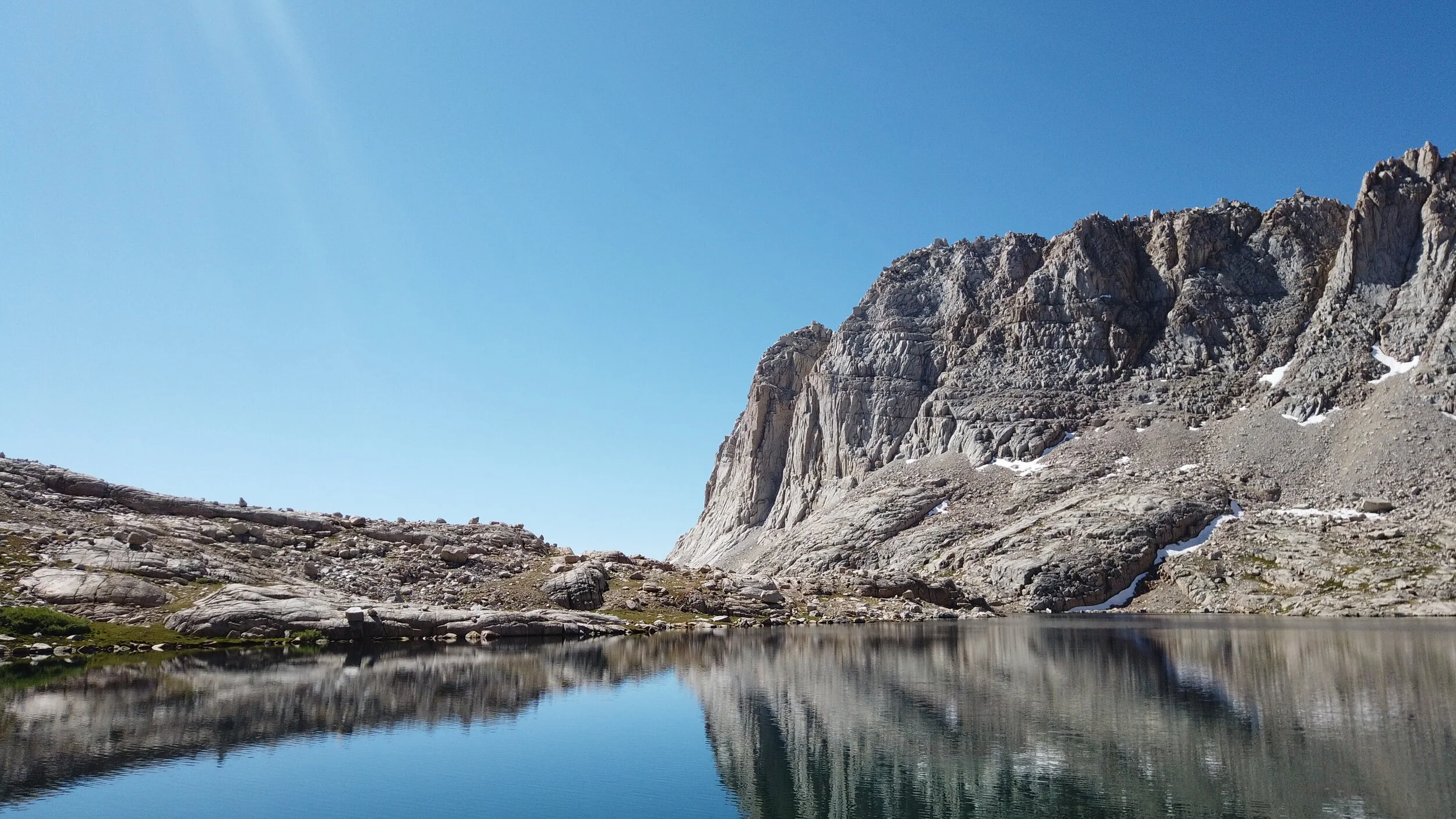
A granite cirque reflected in a Sierra lake

WERE YOU
THERE?

A summit-register photo, an old training log, a Strava file, a date, a correction—or simply the name of the person we should call—can restore a missing chapter.

Share a story or correction →Nothing is treated as final without attribution and a chance for the people involved to weigh in.